
Switched vs Unswitched Sockets: What’s the Difference?
Switched vs Unswitched Sockets: What’s the Difference?
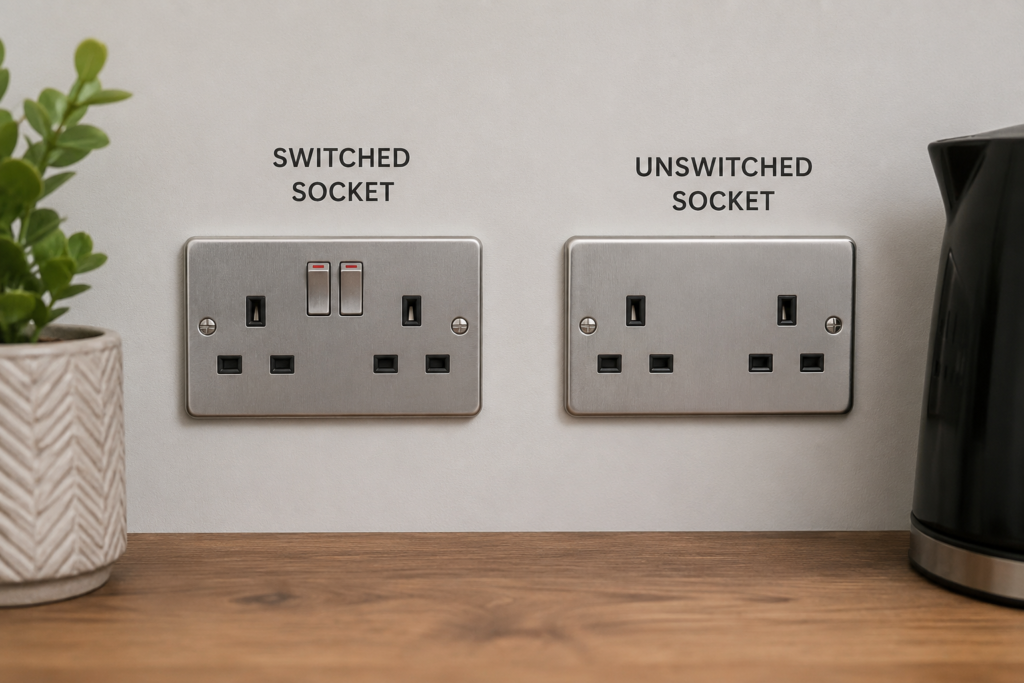
A switched socket has a built-in switch that allows you to turn off the power at the socket, while an unswitched socket remains live whenever the electrical circuit is switched on.
Switched sockets are the most familiar option in UK homes and are usually chosen because they make it easy to disconnect an appliance without removing the plug. Unswitched sockets are less common in everyday living spaces, but they can be useful for fixed appliances, concealed installations and sockets controlled by a separate switch.
In this guide, we explain how switched and unswitched sockets work, where each type is normally used and what you should consider before choosing between them.
What Is a Switched Socket?
A switched socket is an electrical socket with a small rocker switch positioned beside the plug outlet. On a double socket, each outlet will usually have its own individual switch, allowing the two sides to be controlled separately.
When the switch is turned off, the electrical supply to the connected appliance is interrupted at the socket. This means that you can leave the plug in place while preventing the appliance from receiving power through that outlet.
Switched sockets are widely used throughout UK homes and can commonly be found in:
- Living rooms.
- Bedrooms.
- Kitchens.
- Home offices.
- Dining rooms.
- Utility rooms.
- Hallways.
For most people, a switched socket is the most convenient option because the appliance can be turned off without repeatedly pulling the plug out of the wall.
What Is an Unswitched Socket?
An unswitched socket does not have a built-in on and off switch. Once an appliance is plugged in, the socket will continue to supply power whenever the electrical circuit itself is live.
To disconnect the appliance from the supply, you normally need to remove the plug, turn off the circuit or use a separate isolation switch that controls the socket from another location.
Unswitched sockets are often used in situations where the socket is not intended to be controlled directly by the person using the appliance. They may be installed:
- Behind built-in appliances.
- Inside kitchen cabinets.
- Behind televisions or wall-mounted equipment.
- For sockets controlled by a separate wall switch.
- In commercial or specialist installations.
- Where a cleaner, more minimal faceplate is preferred.
Although unswitched sockets are perfectly normal electrical accessories, their suitability depends on how and where they will be used.
What Is the Main Difference Between Switched and Unswitched Sockets?
The main difference is whether the electrical supply can be controlled directly from the socket faceplate.
A switched socket allows you to stop the power supply by pressing the built-in switch. An unswitched socket does not provide this local control, so the plug must usually be removed or the power must be isolated somewhere else.
The switch does not change the normal voltage of the socket or make an appliance use less electricity while it is operating. It simply provides a convenient way to connect or disconnect the supply at that particular outlet.
For appliances that are plugged in and unplugged regularly, the switched version is usually easier to use. An unswitched socket may make more sense when the outlet is hidden, permanently occupied or controlled by another switch.
Are Switched Sockets Safer?
A switched socket is not automatically safer than a correctly installed unswitched socket. Both types should be suitable for the installation, manufactured to the relevant standards and installed correctly.
However, a switched socket can make it easier to disconnect an appliance without removing the plug. This may be useful when you want to turn off a device after use or before cleaning it.
It is important to remember that turning off the switch on the socket should not be treated as a substitute for safe electrical isolation when electrical work is being carried out. Electrical work should only be completed by someone with the appropriate knowledge and skills.
You should stop using a socket and arrange for it to be checked if you notice:
- A burning smell.
- Unusual heat around the socket or plug.
- Crackling or buzzing sounds.
- Brown marks or discolouration.
- A loose or damaged switch.
- A plug that does not sit securely.
- Visible cracks in the faceplate.
These warning signs can indicate a damaged accessory, a loose connection or another electrical problem that should not be ignored.
Does Turning Off a Switched Socket Save Electricity?
Turning off a switched socket may prevent some appliances from continuing to use standby power, but the amount saved depends entirely on the appliance.
Some televisions, chargers, speakers, kitchen appliances and smart devices continue to draw a small amount of electricity while they are plugged in but not actively being used. Switching the socket off can stop this standby consumption.
However, many modern appliances use very little power in standby mode. Switching off every socket in the home is therefore unlikely to produce a dramatic reduction in an electricity bill on its own.
There are also appliances that should not be switched off without checking the manufacturer’s instructions. Routers, recording devices, smart home hubs and appliances with clocks or programmed settings may need a continuous supply to work as intended.
When Should You Choose a Switched Socket?
A switched socket is usually the best choice for general use around the home. It gives you control at the point where the appliance is connected and is familiar to most people in the UK.
Switched sockets are particularly useful for:
- Kettles, toasters and other countertop appliances.
- Televisions and entertainment equipment.
- Bedside lamps and chargers.
- Computers, monitors and printers.
- Hair dryers and styling equipment.
- Vacuum cleaners and temporary appliances.
- Devices that you prefer to disconnect after use.
They are also useful in rooms where several different people may use the socket, as it is immediately clear how the power can be turned off.
If you are choosing between different socket sizes, read our guide Single vs Double Sockets: Which Should You Choose?.
When Should You Choose an Unswitched Socket?
An unswitched socket may be suitable when direct control at the socket is unnecessary or when another switch already controls the supply.
For example, a socket hidden behind a built-in appliance may be paired with a separate accessible switch or fused connection unit. This allows the appliance to be isolated without moving it or reaching behind it.
Unswitched sockets may also be chosen for:
- Built-in fridges and freezers.
- Dishwashers and washing machines.
- Integrated ovens or other fixed equipment, where suitable for the installation.
- Wall-mounted televisions.
- Display equipment.
- Sockets controlled by a separate switch.
- Minimalist interiors where a plain faceplate is preferred.
The correct arrangement depends on the appliance, the wiring design and the manufacturer’s instructions. A hidden socket should still be installed in a way that allows the appliance to be safely disconnected when required.
Are Unswitched Sockets Always Live?
An unswitched socket will normally remain live while the circuit supplying it is on. Unlike a switched socket, there is no control on the faceplate that allows the user to turn the outlet off directly.
However, this does not necessarily mean that there is no way to control it. The socket may be connected to a separate wall switch, fused connection unit, timer, relay or another control device.
Before using an unswitched socket, it is worth understanding how the installation has been designed and where the relevant isolation point is located.
Can You Replace a Switched Socket with an Unswitched Socket?
In some installations, a switched socket can be replaced with an unswitched version of the correct type and size. However, the replacement should be suitable for the circuit, the location and the intended use.
The installer should consider:
- The condition of the existing wiring.
- The size and depth of the back box.
- Whether another accessible isolation point is available.
- The appliance that will be connected.
- The manufacturer’s installation instructions.
- The relevant requirements for the electrical installation.
Changing a socket is not simply a design decision. The way the appliance will be disconnected and maintained also needs to be considered.
For more information about the space behind a socket, read How to Choose the Right Back Box Depth in the UK.
Can You Replace an Unswitched Socket with a Switched Socket?
It may also be possible to replace an unswitched socket with a switched socket, provided the new accessory is suitable for the existing installation.
In many cases, the faceplate dimensions will be similar, but some decorative, smart or feature-rich sockets require more room behind the plate. The depth of the back box and the amount of wiring inside it should therefore be checked before the replacement is chosen.
If the existing unswitched socket is controlled by another switch, changing it to a switched socket could result in two separate controls operating the same outlet. This is not necessarily a problem, but the arrangement should be clear and practical for the person using it.
Should Kitchen Sockets Be Switched or Unswitched?
Switched sockets are normally the most practical choice above kitchen worktops, where kettles, toasters, coffee machines and other small appliances are used regularly.
The built-in switch makes it easy to turn off the supply after using an appliance without pulling the plug out each time.
For built-in appliances, the arrangement may be different. A socket behind a dishwasher, washing machine or fridge may be unswitched and controlled by a separate accessible switch or fused connection unit.
The exact setup should be planned around the appliance, the kitchen layout and the need to disconnect the equipment safely without having to remove it from its position.
Should Bedroom Sockets Be Switched or Unswitched?
Switched sockets are usually the better option in bedrooms because they provide simple control for bedside lamps, chargers, televisions and other devices.
They are particularly convenient beside a bed, where removing a plug may be awkward. A switched double socket can allow a lamp and charger to remain connected while still being controlled individually.
An unswitched socket might be used behind a wall-mounted television or fixed furniture, especially if it is controlled by a separate switch. For general bedside and everyday use, however, switched sockets are normally more convenient.
Do Smart Sockets Need a Physical Switch?
Smart sockets can usually be controlled through an app, voice assistant or home automation system. Many models also include a physical switch so that the socket can still be operated manually.
A physical control can be useful if the internet connection fails, the app is unavailable or another person in the home wants to use the socket without accessing the smart system.
Before buying a smart socket, check how it can be controlled, whether it requires Wi-Fi or a separate hub and what electrical load it is designed to handle.
You may also find our guide Are Smart Plugs Safe for Heaters, Kettles and High-Power Appliances? useful when choosing smart electrical accessories.
Does a Socket Switch Isolate Both Live and Neutral?
Not every socket switch operates in exactly the same way. Some socket switches disconnect only the live conductor, while double-pole products are designed to disconnect both live and neutral.
For an ordinary customer choosing a socket, the important point is not to assume that pressing the visible switch makes the wiring behind the socket safe to work on.
If electrical work is required, the circuit should be correctly isolated and proved dead using appropriate procedures and equipment. A socket switch is primarily an operating control and should not be relied upon as the only safety measure for working on an electrical installation.
Which Type of Socket Looks Better?
Appearance is largely a matter of personal preference. Switched sockets have visible rocker switches, while unswitched sockets have a simpler faceplate with fewer features.
An unswitched socket can look particularly clean in a minimalist room or when used with decorative metal, glass or screwless faceplates. Switched sockets tend to look more familiar and make their operation obvious.
When choosing a finish, it is worth considering the other electrical accessories in the room. Matching sockets, light switches, dimmers and fused connection units can help create a more consistent appearance.
Read our upcoming guide Decorative Sockets vs Standard White Sockets to compare the available options.
Frequently Asked Questions
What is the difference between a switched and unswitched socket?
A switched socket has a built-in switch that controls the power at the outlet. An unswitched socket has no switch and normally remains live whenever its circuit is on.
Are switched sockets better than unswitched sockets?
Switched sockets are usually more convenient for general household use. Unswitched sockets can be more suitable for fixed appliances, concealed outlets or installations controlled by a separate switch.
Are unswitched sockets safe?
Yes, provided they are suitable for the installation, manufactured correctly and installed by someone with the necessary electrical knowledge and skills.
Does switching a socket off stop electricity use?
Turning off the socket stops the connected appliance from drawing power through that outlet. This may prevent standby consumption, although the amount of electricity saved will depend on the appliance.
Can I leave an appliance plugged into a switched socket?
Yes. Many appliances remain plugged in and are controlled using the socket switch. You should still follow the appliance manufacturer’s instructions and check plugs, cables and sockets regularly for damage.
Do unswitched sockets need a separate switch?
Not in every situation, but fixed or concealed appliances may require an accessible way to disconnect the supply. This may be provided by a separate switch, fused connection unit or another suitable isolation method.
Can I change a switched socket myself?
Electrical work can be dangerous if it is completed incorrectly. If you are not confident that you can isolate the circuit, identify the wiring and complete the work safely, use a qualified electrician.
Are switched sockets required in UK homes?
Switched sockets are very common in UK homes, but unswitched versions are also available and may be used where they are appropriate for the installation.
Final Thoughts
Switched and unswitched sockets can both be suitable choices, but they are designed for slightly different situations.
A switched socket gives you convenient control directly at the outlet and is usually the most practical option for living rooms, bedrooms, kitchens and home offices. An unswitched socket can work well for built-in appliances, concealed connections and installations that already have a separate control point.
Before choosing, think about how the appliance will be used, whether the socket will remain accessible and how the power can be safely disconnected when required. The appearance of the faceplate matters, but the installation and intended use should always come first.
Related Guides
- Single vs Double Sockets: Which Should You Choose?
- USB Sockets vs Standard UK Sockets
- How to Choose the Right Back Box Depth in the UK
- What Is a Shaver Socket?
- How Many Sockets Should a Room Have?
- Decorative Sockets vs Standard White Sockets
- Are Smart Plugs Safe for Heaters, Kettles and High-Power Appliances?
People Also Search For
- switched vs unswitched sockets
- difference between switched and unswitched sockets
- are unswitched sockets safe
- why do UK sockets have switches
- when to use an unswitched socket
- switched or unswitched socket for kitchen appliance
- unswitched socket behind washing machine
- unswitched socket controlled by wall switch
- does switching a socket off save electricity
- can I replace an unswitched socket with a switched socket
- double pole switched socket UK
- decorative switched sockets UK
Leave a comment