
How to Choose the Right Back Box Depth in the UK
How to Choose the Right Back Box Depth in the UK
The correct back box depth depends on the electrical accessory, the amount and size of wiring behind it, the construction of the wall and the manufacturer’s installation requirements. A basic socket or light switch may fit a relatively shallow box, while USB sockets, dimmers, smart switches and decorative accessories often need more space.
Choosing a back box can appear straightforward until the new socket or switch is ready to be installed. The faceplate may have the correct width and fixing points, but the mechanism behind it can be considerably deeper than the accessory it is replacing. Even when the accessory technically fits into the opening, there must still be enough room for the conductors to sit safely without being crushed, sharply bent or forced against the terminals.
This is particularly important when updating an older property. A shallow metal box that was perfectly adequate for a basic white switch may not be suitable for a modern dimmer, USB charging socket or smart control. Discovering this after buying the accessories can lead to extra work, visible spacer frames or the need to choose a different product.
In this guide, we explain the common back box depths used in UK homes, how solid-wall and plasterboard boxes differ, why some accessories need more room and what to check before ordering new switches or sockets.
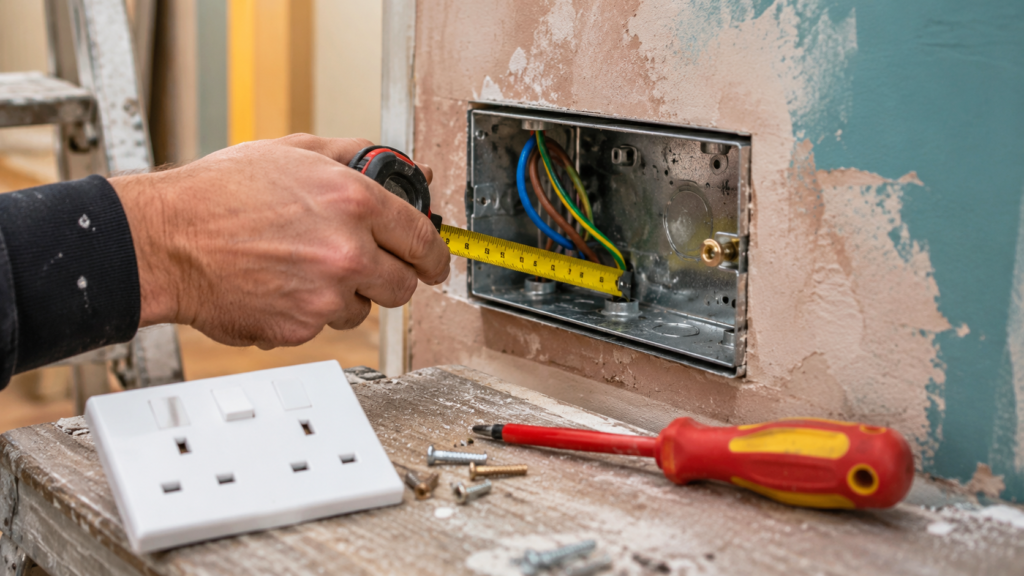
What Is an Electrical Back Box?
A back box is the enclosure positioned behind an electrical accessory such as a socket, light switch, fused connection unit or data outlet. It provides a secure mounting point for the faceplate and contains the electrical connections behind it.
Depending on the wall construction, the box may be:
- A metal box recessed into brick, blockwork or another solid wall.
- A plastic dry-lining box fitted into plasterboard or another hollow wall.
- A surface-mounted box fixed directly onto the face of a wall.
- A specialist box designed for a particular wiring or containment system.
The front of a flush-mounted box should sit in a suitable position relative to the finished wall surface so that the accessory can be fitted securely and sit correctly against the wall.
The back box also helps contain the terminals and wiring. It is not simply an empty space behind the faceplate. Its dimensions, fixing points, cable entries and material all need to suit the installation.
What Does Back Box Depth Mean?
Back box depth refers to the distance from the front edge of the box to its rear surface. In product descriptions, this is normally stated in millimetres.
Common nominal depths found in UK installations include:
- 16 mm.
- 25 mm.
- 35 mm.
- 46 or 47 mm.
Other dimensions are also available, particularly for surface boxes, specialist accessories and commercial installations.
The advertised depth does not always represent the full usable internal space. Knockouts, fixing lugs, cable entries, wall material, screw heads and the shape of the accessory can all reduce the space available for the wiring.
This is why choosing a back box should not be reduced to a simple rule such as “all sockets need 25 mm” or “all decorative switches need 35 mm”. The product’s own installation information should always be checked.
What Are the Common UK Back Box Depths?
16 mm Back Boxes
A 16 mm box is very shallow. It may be used with certain slim, uncomplicated light switches or in older installations where there is limited depth in the wall.
However, the available wiring space is restricted. A shallow box may become difficult to work with if there are several cables, loop connections, earth conductors or a deeper replacement switch.
It is generally not a sensible default choice for modern sockets, dimmers, USB accessories or smart controls unless the accessory manufacturer specifically confirms that the product is suitable.
If an older home already contains 16 mm boxes, check them before choosing new decorative switches. A faceplate that looks thin from the front may still have a substantial mechanism behind it.
25 mm Back Boxes
A 25 mm box is widely used for standard sockets, switches and other relatively simple accessories. Some manufacturers specify a minimum 25 mm flush box for particular conventional socket outlets and switches.
That does not mean every accessory will fit comfortably in every 25 mm box. The suitability also depends on:
- The depth and shape of the mechanism.
- The number of cables entering the box.
- The conductor size.
- The position of the terminals.
- Whether connectors or additional joints are present.
- How much room is needed to bend the conductors safely.
A 25 mm box may be perfectly adequate for a straightforward standard socket with a tidy cable arrangement. It may be too shallow for a more complicated accessory or for an installation containing several stiff conductors.
35 mm Back Boxes
A 35 mm box provides noticeably more working space and is commonly considered when installing deeper accessories.
It may be appropriate for:
- Some decorative sockets and switches.
- Many dimmer switches.
- Certain USB charging sockets.
- Some fused connection units.
- Accessories with larger rear terminals.
- Installations containing additional wiring.
Again, these are examples rather than universal rules. Some products in these categories fit shallower boxes, while others need more than 35 mm.
When a property is being rewired or extensively renovated, choosing 35 mm boxes in suitable locations can provide more flexibility for future accessories. However, the box still needs to suit the wall and the intended product.
46 mm and 47 mm Back Boxes
Deeper boxes around 46 or 47 mm provide additional room for bulky mechanisms, wiring and cable bends.
They may be useful for:
- Smart switches and connected controls.
- Higher-output USB or USB-C sockets.
- Complex dimmer arrangements.
- Multimedia and data accessories.
- Products containing power supplies or electronic modules.
- Installations with several cables entering the same box.
A deeper box is not automatically required for every smart or USB product, but these accessories frequently contain more electronics than a basic mechanical switch or standard socket.
Where the wall construction allows it, additional depth can make installation easier and reduce the risk of the mechanism pressing against the conductors. The final choice should still follow the product documentation and the electrician’s assessment.
How Much Space Is Needed Behind a Socket or Switch?
The accessory needs enough space not only for its own rear projection but also for the wiring connected to it.
Conductors should not have to be crushed into the box or folded into extremely tight bends. Forcing a faceplate backwards with the fixing screws is a warning sign that the box may be too shallow, the wiring may be badly arranged or the accessory may be unsuitable for the existing installation.
The required space is influenced by:
- The overall rear depth of the accessory.
- The location and angle of the terminals.
- The number of live, neutral and protective conductors.
- The stiffness and cross-sectional area of the cables.
- Whether the circuit loops through the accessory.
- Whether additional connectors are present.
- The position from which the cables enter the box.
Two products with a similar front appearance may need different depths because their internal construction and terminal layouts are different.
It is therefore better to check the stated minimum mounting depth than to estimate the requirement from a product photograph.
Do Single and Double Sockets Use Different Back Boxes?
A standard single accessory and a standard double accessory normally use boxes with different front dimensions.
A single-gang box is intended for one-gang accessories such as many single sockets, switches, fused connection units and data outlets. A two-gang box is wider and is normally used for a standard UK double socket or a wider multi-control accessory.
The term “gang” describes the format or width of the accessory. It does not directly tell you the required depth.
For example, you may encounter:
- A one-gang 25 mm box.
- A one-gang 35 mm box.
- A two-gang 25 mm box.
- A two-gang 35 mm box.
- A two-gang 47 mm box.
When replacing a single socket with a double socket, changing only the faceplate is generally not sufficient. A wider box and a larger wall opening are normally required unless a suitable purpose-designed conversion product is used.
Read Single vs Double Sockets: Which Should You Choose? for a broader comparison.
Which Back Box Is Used in a Solid Wall?
Metal flush boxes are commonly installed in solid walls made from brick, block or similar material. A recess is formed in the wall, the box is secured in position and the surrounding surface is finished around it.
Metal boxes usually have removable knockouts for cable or conduit entry. The installer chooses suitable entries and protects the cables where necessary.
When selecting the depth for a solid wall, the available construction depth must be considered. Creating a deeper recess is not always straightforward, particularly in thin partitions, near wall edges or where the structure could be affected.
The position of existing cables and other services must also be checked before cutting into a wall.
A metal box is often connected to the circuit protective conductor where required. Earthing and continuity arrangements form part of the electrical installation and should be handled correctly by a competent installer.
Which Back Box Is Used in Plasterboard?
Dry-lining boxes are designed for hollow plasterboard walls. They normally have retaining lugs that grip the rear of the board as the fixing screws are tightened.
The box must match the thickness of the board and have sufficient clearance behind it. Wall insulation, timber studs, metal framing, pipes and other services can limit the space available.
Before cutting the opening, the installer needs to confirm that the intended location is clear. A box cannot occupy the same space as a stud or pipe.
Dry-lining boxes are available in different gang sizes and depths. The deepest available box is not always suitable simply because the wall is hollow. There must be enough unobstructed space behind the plasterboard, and the box needs to remain securely supported.
When Is a Surface-Mounted Box Used?
A surface box is fitted onto the face of the wall rather than recessed into it. The cables may enter through surface trunking, conduit or another suitable route.
Surface-mounted accessories are often used in:
- Garages.
- Workshops.
- Utility areas.
- Outbuildings.
- Commercial spaces.
- Locations where chasing the wall is impractical.
They can also provide a solution where an existing flush box is too shallow, although the appearance is different and the complete installation needs to be suitable.
Surface boxes come in different depths, materials and levels of environmental protection. A box used in a dry bedroom is not automatically suitable for a damp garage or outdoor installation.
What Back Box Depth Is Needed for a USB Socket?
There is no single back box depth that applies to every USB socket.
A USB socket contains charging electronics in addition to the normal socket components. This often increases the rear projection, but product designs vary significantly.
Some models may be designed for a 25 mm box under suitable installation conditions. Others may specify 35 mm, 47 mm or another minimum depth.
Before ordering a USB socket, check:
- The manufacturer’s stated minimum box depth.
- The physical depth of the rear module.
- The location of the terminals.
- The number of cables already inside the box.
- Whether the faceplate is flat, raised or screwless.
Do not assume that a new USB-C socket will fit because an older USB-A model fitted previously. Higher-output charging electronics can have a different internal layout.
For more information, read USB Sockets vs Standard UK Sockets.
Do Decorative Sockets Need Deeper Back Boxes?
Some decorative sockets and switches need more depth than basic white accessories, but this is not true of every product.
Decorative products can include:
- Brushed steel accessories.
- Polished chrome faceplates.
- Black nickel finishes.
- Glass switches and sockets.
- Screwless flat plates.
- Raised decorative plates.
The external thickness of the faceplate does not always reveal the required mounting depth. A very slim-looking screwless plate may conceal a deeper mechanism behind the wall.
Flat plate accessories can be less forgiving when the box is recessed too far, the wall is uneven or there is insufficient space behind the mechanism. Because the front is designed to sit closely against the wall, poor preparation may be more noticeable.
Always check the technical data for the exact product range rather than relying on a general description such as “decorative socket”.
What Back Box Depth Is Needed for a Dimmer Switch?
Dimmer switches frequently require more depth than simple mechanical light switches because the dimming mechanism and electronic components occupy additional space.
The required depth depends on:
- The dimmer technology.
- The number of dimmer modules.
- The load rating.
- The terminal arrangement.
- The faceplate design.
- The amount of wiring in the box.
A single simple switch may fit comfortably in an existing shallow box, while a multi-gang dimmer may require considerably more room.
Heat management can also matter with dimmers. The manufacturer’s installation instructions may include information about loading, grouping controls and any reduction in capacity required when several dimmers are fitted together.
Do not force a dimmer into a shallow box or ignore the manufacturer’s minimum depth.
What Back Box Depth Is Needed for a Smart Switch?
Smart switches can contain relays, wireless communication components, power supplies and control electronics. They may therefore be deeper than a traditional light switch.
Some smart switches also require a neutral conductor at the switch position, while other designs work differently. The existing wiring arrangement must be checked before the product is purchased or installed.
Consider the following:
- The specified minimum mounting depth.
- Whether a neutral connection is required.
- The number of controlled circuits.
- The wall box format.
- The wiring space around the module.
- Whether a separate hub or module is used.
A deep box alone does not guarantee that a smart switch is compatible with an existing circuit. Both the physical and electrical requirements need to be satisfied.
What Back Box Depth Is Needed for a Shaver Socket?
Shaver sockets contain an isolating transformer and are substantially deeper than basic light switches or socket outlets.
The exact mounting requirements depend on the product. They may require a purpose-suitable box and considerable space behind the faceplate.
Because shaver sockets are commonly installed in bathrooms, their location and installation must also comply with the applicable requirements for electrical equipment in rooms containing a bath or shower.
Do not select the box solely by comparing the front dimensions with a normal socket. Check the shaver socket manufacturer’s instructions and have the installation assessed by a qualified electrician.
Read What Is a Shaver Socket? for more information about its purpose and use.
What About Fused Connection Units?
A fused connection unit, often called an FCU or fused spur, contains a fuse and may also include a switch, indicator or flex outlet.
Some basic models can fit standard boxes, while more complex versions may need additional depth. The space required depends on the terminal arrangement, the number of cables and whether a flexible cable exits from the unit.
Where several conductors and a flex are present, a deeper box can make the termination less cramped. The manufacturer’s minimum box depth remains the starting point.
What Happens If the Existing Back Box Is Too Shallow?
If the existing box is too shallow, the correct solution depends on the wall, the accessory and the amount of additional space required.
Possible options may include:
- Replacing the box with a deeper one.
- Deepening the wall recess where safe and practical.
- Using a suitable surface-mounted box.
- Using a compatible spacer or pattress extension.
- Choosing a shallower accessory.
A spacer can bring the faceplate forward and create additional room, but it changes the finished appearance. It must also be suitable for the accessory and installed correctly.
Simply tightening the screws until the faceplate closes is not an acceptable solution. This may place pressure on the conductors, terminals or mechanism.
How Do You Check the Depth of an Existing Back Box?
Checking a back box involves working around electrical wiring, so the circuit must be made safe and appropriate precautions taken. Anyone who is uncertain should ask a qualified electrician to inspect it.
The box depth can usually be established by measuring from its front edge to the rear, but the usable space should also be examined.
Important observations include:
- Whether the box is metal or plastic.
- Whether it is one-gang or two-gang.
- The nominal depth.
- The number and size of cables.
- The cable entry positions.
- The condition of the fixing lugs.
- How far the box sits behind the finished wall.
- Whether there are connectors or joints inside.
Photographs and measurements can help when comparing the installation with product specifications, but they do not replace an electrical assessment.
What If the Back Box Is Recessed Too Far into the Wall?
A box that sits too far behind the finished wall can make it difficult to secure the accessory correctly. This may happen after a wall has been overboarded, tiled, replastered or covered with another finish.
Longer screws alone may not resolve every problem. The installer needs to consider the security of the fixing, the condition of the box, the gap around the accessory and any requirements relating to the enclosure of the connections.
Suitable extension products or other corrective work may be required. The correct solution depends on the construction and the extent of the recess.
What If the Back Box Projects Beyond the Wall?
If a flush box projects beyond the finished wall, the faceplate may not sit flat. This can leave an uneven gap and make the installation look poorly finished.
The box may need repositioning or the surrounding surface may need correction. Attempting to bend or distort the faceplate against an uneven box can damage the accessory.
Flat decorative plates are particularly likely to reveal imperfections around the mounting surface.
How Do Tiles and Wall Panels Affect Back Box Depth?
Tiles, splashbacks and decorative panels increase the thickness of the finished wall surface. If this is not allowed for, the original box may end up recessed behind the new finish.
Before tiling or panelling, consider:
- The thickness of the tile or panel.
- The adhesive layer.
- The final position of the accessory.
- Whether the fixing screws will remain suitable.
- Whether the box opening will remain accessible and correctly finished.
This is especially relevant in kitchens and bathrooms, where accessories may be fitted into tiled surfaces.
Can You Use a Deeper Back Box Than Necessary?
In many suitable installations, a deeper box can provide more wiring space and future flexibility. However, it should not be chosen without considering the wall construction.
A deeper chase may be inappropriate in a thin wall or near structural features. In a hollow wall, insulation, framing or services may prevent the box from fitting.
The box must also be securely installed and compatible with the accessory. More depth is useful only when the surrounding construction can safely accommodate it.
Which Back Box Depth Should You Choose During a Renovation?
When the walls are already open, it is worth deciding which accessories will be installed before the boxes are purchased.
Create a schedule showing:
- The type of accessory at each position.
- The manufacturer and product range.
- The gang size.
- The required minimum depth.
- The wall construction.
- Any future smart or USB features.
If the final decorative range has not yet been selected, discuss sensible future allowance with the electrician. Installing boxes with additional usable depth may provide flexibility, but the wall must remain suitable.
Do not assume that every accessory throughout the property needs the same box. A basic landing switch, double USB-C socket, multi-gang dimmer and bathroom shaver outlet may all have different requirements.
Common Back Box Mistakes
Many fitting problems can be avoided by checking the product specification before installation.
Common mistakes include:
- Assuming all sockets fit a 25 mm box.
- Assuming every USB socket needs exactly 35 mm.
- Choosing the box before choosing the accessory.
- Ignoring the space occupied by the wiring.
- Forcing conductors into sharp bends.
- Using the fixing screws to pull an overcrowded accessory into place.
- Failing to allow for tiles or wall panels.
- Confusing gang size with depth.
- Buying decorative accessories based only on their front appearance.
- Failing to check the manufacturer’s instructions.
- Cutting into a wall without checking for cables, pipes or structural limitations.
Another common mistake is replacing only one accessory and assuming the new range will fit all the existing boxes in the house. Box depths often vary between rooms, particularly in older properties that have been altered over time.
What Should You Check Before Buying New Sockets or Switches?
Before placing an order, gather as much information as possible about both the accessory and the installation.
Check:
- The exact product code.
- The manufacturer’s data sheet.
- The minimum recommended box depth.
- The rear projection of the mechanism.
- The required gang size.
- The type and condition of the existing box.
- The amount of wiring already present.
- The finished wall material.
- Whether the product needs a neutral or other special connection.
For an entire room or property, it may be useful to remove and inspect a representative selection of accessories safely rather than assuming every box is identical.
Frequently Asked Questions
Is a 25 mm back box deep enough for a socket?
A 25 mm box is suitable for some standard socket outlets when the manufacturer permits it and there is enough room for the wiring. It is not automatically suitable for every socket, particularly products with USB charging, smart features or deeper decorative mechanisms.
Should I use a 25 mm or 35 mm back box?
Choose the depth according to the exact accessory and the wiring space required. A basic product may specify 25 mm, while a deeper model may require 35 mm or more. A deeper box can provide extra space where the wall construction allows it.
Do USB sockets need a 35 mm back box?
Some do, but not all. The minimum depth varies between products. Check the technical data for the exact USB socket rather than applying a general rule.
Do smart switches need deep back boxes?
Many smart switches have deeper electronic modules, but the requirement depends on the design. Some may fit a 35 mm box, while others need more or have different wiring requirements.
What back box is needed for a double socket?
A standard double socket normally uses a two-gang box. The required depth depends on the socket model, terminals and wiring arrangement.
Can a single socket fit a double back box?
A standard single socket is intended for a one-gang box and will not normally fit a standard two-gang opening correctly without a suitable conversion product.
Can I replace a 25 mm box with a 35 mm box?
It may be possible, but the wall must have enough safe depth and the work may involve enlarging the recess. Cables, pipes, wall thickness and structural considerations must be checked.
Can I use a spacer if the back box is too shallow?
A compatible spacer may provide additional room by bringing the accessory forward. It changes the appearance and must be suitable for the product and installation.
Why will my new socket not sit flat?
Possible causes include an overcrowded or shallow box, badly arranged conductors, an uneven wall, a projecting box, trapped insulation, incorrect screws or a mechanism that is deeper than the available space.
Are metal and plastic back boxes interchangeable?
They serve similar mounting purposes but are normally selected for different wall constructions and installation methods. Metal flush boxes are common in solid walls, while dry-lining boxes are designed for hollow plasterboard walls.
What depth is needed for a dimmer switch?
The required depth varies according to the dimmer mechanism and the number of modules. Check the manufacturer’s minimum depth; many dimmers need more room than a standard mechanical switch.
Can I install the back box myself?
Electrical installation work must be completed safely and in accordance with the applicable requirements. Creating the opening also carries risks from hidden cables, pipes and the wall structure. Use a qualified electrician where appropriate and do not work on live wiring.
Final Thoughts
There is no single back box depth that is correct for every UK socket and switch. A 25 mm box may suit a straightforward standard accessory, while a USB socket, dimmer, smart switch or shaver outlet may require significantly more room.
The safest approach is to choose the electrical accessory first, read its technical information and then confirm that the intended box provides enough usable space for both the mechanism and the wiring.
Wall construction also matters. A box that can be recessed easily into one wall may be unsuitable for another because of limited thickness, framing, insulation, pipes or cables.
During a renovation, planning the boxes and accessories together can prevent delays and help future-proof the installation. In an existing property, inspect the boxes before ordering a full set of replacement sockets or switches.
Never force an accessory into an overcrowded enclosure. Where there is any doubt about the box, wiring or compatibility of the product, ask a qualified electrician to assess the installation.
Related Guides
- Single vs Double Sockets: Which Should You Choose?
- Switched vs Unswitched Sockets: What’s the Difference?
- USB Sockets vs Standard UK Sockets
- What Is a Shaver Socket?
- How Many Sockets Should a Room Have?
- Decorative Sockets vs Standard White Sockets
Further Reading and Official Guidance
- Electrical Safety First – Wiring Regulations Help
- Electrical Safety First – Best Practice Guides
- Institution of Engineering and Technology – BS 7671 Information
People Also Search For
- what depth back box do I need
- 25mm or 35mm back box
- UK socket back box depth
- back box depth for double socket
- back box depth for USB socket
- back box depth for dimmer switch
- back box depth for smart switch
- do decorative sockets need deeper back boxes
- can a USB socket fit a 25mm back box
- 35mm back box for socket
- 47mm back box uses
- single gang and double gang back boxes
- metal back box vs dry lining box
- back box too shallow for socket
- socket spacer for shallow back box
- how to measure back box depth
- best back box for plasterboard
- best back box for solid wall
- minimum mounting box depth UK socket
- why does my socket not sit flat

Leave a comment