Common Mistakes When Buying Sockets and Switches (and How to Avoid Them)
Common Mistakes When Buying Sockets and Switches (and How to Avoid Them)
Choosing new sockets and switches may seem straightforward, but it’s surprisingly easy to overlook details that can affect appearance, functionality and long-term satisfaction. From selecting the wrong finish to forgetting about back box depth, small mistakes can lead to unnecessary expense and frustration.
Whether you’re renovating a single room or an entire property, electrical accessories are among the finishing touches you’ll see and use every day. Spending a little extra time planning your choices can help create a more practical, attractive and future-proof installation.
This guide highlights some of the most common mistakes homeowners make when buying sockets and switches in the UK and explains how to avoid them.
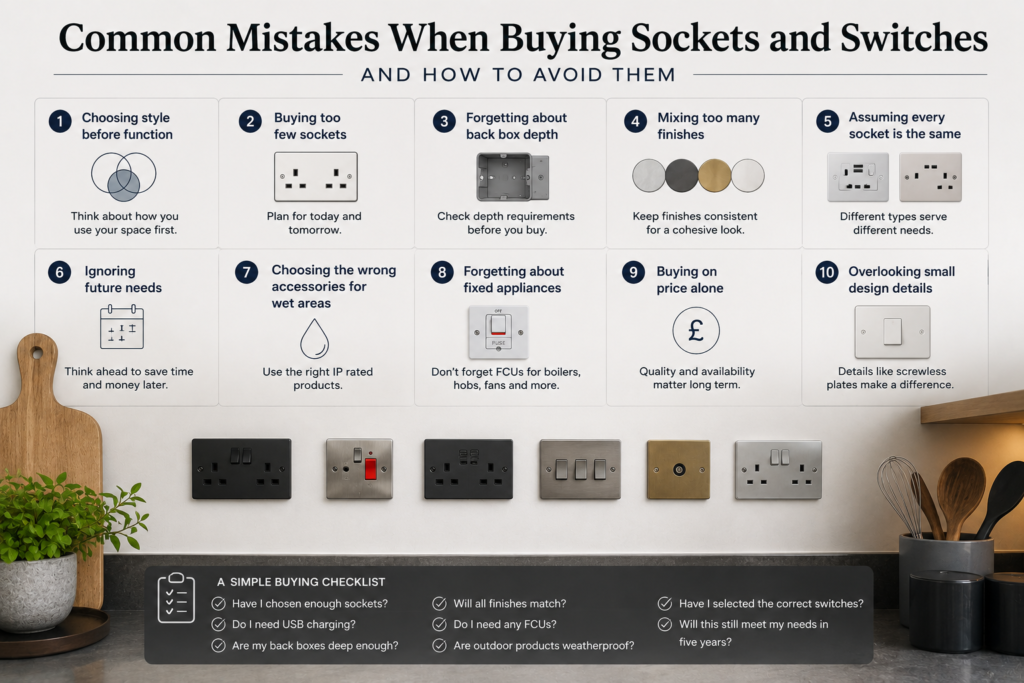
1. Choosing Style Before Function
It’s easy to fall in love with a particular finish or design, especially when browsing modern collections online. However, appearance should never be the only consideration.
Before deciding on a finish, think about how each accessory will actually be used. For example:
- Will you need USB charging for phones and tablets?
- Would double sockets be more practical than singles?
- Are switched or unswitched sockets more suitable?
- Do you need a fused connection unit for fixed appliances?
Once you’ve identified the functional requirements, you can then choose the finish that best suits your interior.
2. Buying Too Few Sockets
One of the most common regrets after a renovation is not installing enough sockets.
Modern households typically use far more electrical devices than homes built twenty or thirty years ago. Televisions, computers, speakers, chargers, kitchen appliances and smart home devices all compete for available outlets.
Installing additional sockets during a renovation is usually much easier than adding them later.
Read our guide How Many Sockets Should a Room Have? for planning advice.
3. Forgetting About Back Box Depth
Many decorative sockets, USB sockets and smart accessories require deeper back boxes than older installations.
Homeowners sometimes purchase new accessories only to discover they won’t fit the existing wall box.
Checking the required installation depth before ordering can prevent delays and unnecessary returns.
Learn more in How to Choose the Right Back Box Depth in the UK.
4. Mixing Too Many Finishes
Matt black, brushed brass, chrome, glass, white plastic and brushed steel all have their place, but using too many finishes within the same room can make a space feel unplanned.
Instead, choose one finish that complements your:
- Door handles.
- Lighting.
- Cabinet hardware.
- Kitchen appliances.
- Furniture.
A consistent approach usually produces a cleaner and more professional result.
5. Assuming Every Socket Is the Same
At first glance, many sockets appear almost identical. In reality, there are numerous variations designed for different applications.
These include:
- Single sockets.
- Double sockets.
- USB-A sockets.
- USB-C sockets.
- Switched sockets.
- Unswitched sockets.
- Weatherproof sockets.
- Outdoor sockets.
Understanding these differences helps ensure you select the right accessory for each location.
6. Ignoring Future Needs
Think beyond today’s requirements.
If you’re already redecorating, consider whether your electrical needs may change over the next five to ten years.
For example:
- Will you work from home?
- Will children need additional charging points?
- Are USB-C devices becoming more common in your household?
- Might you install smart home products later?
Planning ahead often saves both time and money in the future.
7. Choosing the Wrong Accessories for Wet Areas
Bathrooms, utility rooms and outdoor spaces have different requirements from dry living areas.
Choosing products suitable for the environment is just as important as selecting the correct style.
Outdoor accessories, for example, typically require weather-resistant enclosures with an appropriate IP rating.
Read Socket IP Ratings Explained for more information.
8. Forgetting About Fixed Appliances
Not every electrical appliance plugs into a standard socket.
Boilers, cooker hoods, heated towel rails and many extractor fans are permanently connected using a Fused Connection Unit (FCU).
When renovating, make sure these accessories are included in your plans so that everything matches throughout the property.
Read What Is a Fused Connection Unit (FCU)?.
9. Buying on Price Alone
Budget is always important, but the cheapest option isn’t necessarily the best value.
Electrical accessories are used every day for many years. Paying a little more for well-designed products that suit your home can often provide better long-term satisfaction than simply choosing the lowest price.
It’s also worth considering the availability of matching accessories if you plan to expand or update other rooms in the future.
10. Overlooking Small Design Details
Small details can make a significant difference to the finished appearance of a room.
Examples include:
- Screwless faceplates.
- Low-profile designs.
- Matching switches and sockets.
- Consistent rocker colours.
- Matching cooker switches and FCUs.
These finishing touches often help create a more cohesive interior.
A Simple Buying Checklist
Before placing your order, ask yourself:
- Have I chosen enough sockets?
- Do I need USB charging?
- Are my back boxes deep enough?
- Will all finishes match?
- Do I need any FCUs?
- Are outdoor products weatherproof?
- Have I selected the correct switches?
- Will this still meet my needs in five years?
Answering these questions before buying can help avoid many common problems.
Frequently Asked Questions
Should I choose decorative sockets or standard white?
Both are excellent options. Decorative finishes offer a more premium appearance, while standard white sockets remain a practical and timeless choice.
Do I need USB sockets everywhere?
No. They are most useful in locations where phones, tablets and other portable devices are regularly charged.
Can I mix different finishes throughout my home?
Yes, but it’s generally best to keep a consistent finish within each room or living area.
Why won’t my new socket fit the wall?
One common reason is insufficient back box depth, particularly with USB and decorative accessories.
Do outdoor sockets need a higher IP rating?
Yes. Outdoor installations typically require weather-resistant accessories suitable for external use.
Final Thoughts
Buying sockets and switches is about far more than choosing a colour or finish. Considering functionality, future requirements, installation compatibility and the environment where each accessory will be used can help you avoid costly mistakes and create a home that’s both practical and visually consistent.
With careful planning, you’ll end up with electrical accessories that not only look great but continue to meet your needs for many years to come.
Related Guides
- Single vs Double Sockets: Which Should You Choose?
- Decorative Sockets vs Standard White Sockets
- How to Choose the Right Back Box Depth in the UK
- Socket IP Ratings Explained
- What Is a Fused Connection Unit (FCU)?
- What Is a Shaver Socket?
Further Reading
People Also Search For
- buying electrical sockets UK
- common electrical renovation mistakes
- USB sockets worth it
- best sockets for a new home
- decorative sockets guide
- back box depth explained
- IP rating for outdoor sockets
- fused connection unit explained
- modern electrical accessories UK
- choosing sockets and switches


Leave a comment