
What Is a Fused Connection Unit (FCU)? A Complete UK Homeowner’s Guide
What Is a Fused Connection Unit (FCU)? A Complete UK Homeowner’s Guide
A Fused Connection Unit (FCU), often called a fused spur, is a permanently connected electrical accessory that contains its own replaceable fuse. It protects appliances connected to a circuit by limiting the current that can flow through that individual piece of equipment, even when the main circuit is protected by a higher-rated breaker.
If you’ve ever looked around your home and noticed what appears to be a light switch with a small fuse holder on the front, you’ve probably seen a fused connection unit. Although many homeowners see them every day, few know what they actually do or why they’re installed.
Understanding the purpose of an FCU is useful whether you’re renovating your home, replacing electrical accessories or simply trying to identify the different components of your electrical installation.
This guide explains what a fused connection unit is, how it works, where it is commonly used and why it plays an important role in electrical safety in UK homes.
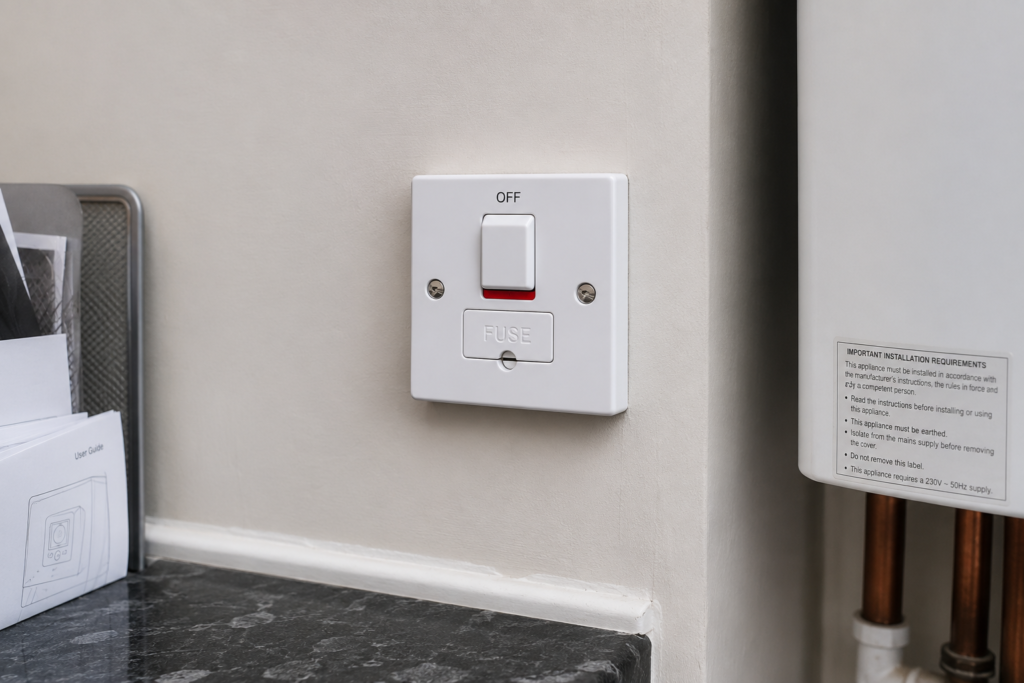
What Is a Fused Connection Unit?
A fused connection unit is a fixed electrical accessory that connects an appliance permanently to the electrical supply while providing its own replaceable fuse.
Unlike a standard 13A socket, an FCU is designed for appliances that are not intended to be plugged in and unplugged regularly. Instead, the appliance is wired directly into the unit.
The built-in fuse protects the connected appliance by disconnecting the supply if excessive current flows.
In most homes, the circuit itself may already be protected by a circuit breaker rated at 16A, 20A or 32A. The FCU adds another level of protection by allowing the individual appliance to use a much smaller fuse, such as 3A or 5A, where appropriate.
How Does an FCU Work?
An FCU works in much the same way as the fuse inside a standard UK plug.
Electricity passes through the fuse before reaching the appliance. If a fault causes the current to exceed the fuse rating, the fuse element melts, breaking the circuit and disconnecting the appliance from the electrical supply.
This helps protect both the appliance and the fixed wiring from damage caused by excessive current.
Why Not Just Use a Normal Socket?
Some appliances are designed to remain permanently connected rather than plugged into a socket.
Examples include:
- Extractor fans.
- Boilers.
- Kitchen cooker hoods.
- Heated towel rails.
- Certain electric heaters.
- Waste disposal units.
- Water heaters.
- Underfloor heating controls.
Using an FCU creates a neat permanent installation while providing appropriate protection for that specific appliance.
Switched vs Unswitched FCUs
There are two main types of fused connection unit.
Switched FCU
A switched FCU includes a rocker switch that allows the connected appliance to be isolated without removing the fuse or switching off the circuit breaker.
This is the most common type found in UK homes.
Unswitched FCU
An unswitched version does not include an on/off switch.
These are often used where accidental switching off could cause problems or where regular isolation is unnecessary.
Where Are FCUs Commonly Installed?
You may find fused connection units throughout a typical UK property.
Common locations include:
- Next to boilers.
- Above kitchen worktops.
- Inside kitchen cupboards.
- Near extractor fans.
- Adjacent to immersion heaters.
- Close to heated towel rails.
- Beside electric fireplaces.
- Near underfloor heating controls.
Many are positioned where they remain accessible for maintenance while being as unobtrusive as possible.
Which Fuse Should Be Used?
The correct fuse depends entirely on the appliance manufacturer’s requirements.
Common fuse ratings include:
- 3A
- 5A
- 13A
Choosing the correct fuse is important because it provides protection specifically matched to the appliance.
A larger fuse does not provide “better” protection. In fact, fitting an incorrectly rated fuse may reduce the effectiveness of the safety system.
Can an FCU Be Used as an Isolator?
Yes, a switched fused connection unit is frequently used as a local means of isolation.
This allows maintenance work to be carried out on an appliance after it has been safely isolated from the electrical supply.
For certain appliances, additional isolation requirements may also apply depending on the installation and the relevant electrical regulations.
Do FCUs Need Maintenance?
Under normal circumstances, fused connection units require very little maintenance.
However, homeowners should periodically check for:
- Cracked faceplates.
- Signs of overheating.
- Discolouration.
- Loose accessories.
- Damage caused by moisture.
If damage is noticed, the accessory should be inspected by a suitably competent person before further use.
Are Decorative FCUs Available?
Yes.
Most modern electrical accessory ranges include matching fused connection units alongside sockets, switches and other wiring accessories.
Popular finishes include:
- Matt black.
- Brushed steel.
- Polished chrome.
- Brushed brass.
- Antique brass.
- Glass.
This makes it easy to maintain a consistent appearance throughout a room while still providing the necessary electrical protection.
Can You Replace an Existing FCU?
Like other fixed electrical accessories, an existing FCU can be replaced with a suitable equivalent when appropriate.
However, any work on fixed electrical installations should be carried out safely and, where required, by a suitably qualified electrician.
If you are unsure about the wiring, the condition of the circuit or the correct replacement product, professional advice should always be sought.
FCU vs Standard Socket
| Feature | Standard Socket | Fused Connection Unit |
|---|---|---|
| Plug-in appliance | Yes | No |
| Permanent connection | No | Yes |
| Replaceable fuse | Inside the plug | Inside the FCU |
| Local isolation | By unplugging | Usually by switch |
| Typical use | Portable appliances | Fixed appliances |
Common Misunderstandings
- An FCU is not simply another type of light switch.
- It is not intended for plugging portable appliances into.
- It should not automatically be fitted with a 13A fuse.
- Replacing a fuse with a higher rating is not a safe solution to repeated failures.
- The fuse rating should always match the appliance manufacturer’s requirements.
Frequently Asked Questions
Is an FCU the same as a fused spur?
In everyday UK usage, the terms “Fused Connection Unit” and “fused spur” are often used interchangeably.
Can I plug something into an FCU?
No. An FCU is designed for permanently wired appliances rather than plug-in devices.
Can an FCU have a 13A fuse?
Yes, if this is appropriate for the connected appliance and the installation.
Why does my boiler have an FCU?
Many boilers are permanently connected to the electrical supply and use an FCU to provide dedicated overcurrent protection and local isolation.
Can decorative ranges include matching FCUs?
Yes. Most premium electrical accessory collections include matching fused connection units to create a consistent appearance throughout the property.
Final Thoughts
A fused connection unit is one of the most common yet least understood electrical accessories found in UK homes. Although it may resemble a simple switch, it performs an important role by providing dedicated fuse protection and a convenient means of isolating permanently connected appliances.
Whether you’re renovating a kitchen, upgrading a boiler installation or selecting matching electrical accessories for a new home, understanding the purpose of an FCU will help you make more informed decisions and better understand your property’s electrical installation.
Related Guides
- Decorative Sockets vs Standard White Sockets
- How to Choose the Right Back Box Depth in the UK
- USB Sockets vs Standard UK Sockets
- What Is a Shaver Socket?
Further Reading
People Also Search For
- what is a fused spur
- FCU meaning
- switched fused spur
- unswitched fused spur
- boiler fused spur
- FCU vs socket
- what fuse should an FCU use
- permanently wired appliances UK
- electrical accessories explained
- UK fused connection unit guide


Leave a comment