
Are Dash Cams Legal in the UK and Europe? Rules for Driving Abroad
Are Dash Cams Legal in the UK and Europe? Rules for Driving Abroad
You’ve packed the car, checked your tyres, sorted the insurance and programmed the sat nav. Your dash cam is ready to record the journey too.
But there’s one thing you might not have checked: are you actually allowed to use it in every country you’re driving through?
It’s an easy detail to overlook. After all, a dash cam that’s perfectly ordinary on a British motorway doesn’t suddenly look any different when you cross into France, Belgium or Germany.
Unfortunately, the rules aren’t quite that simple.
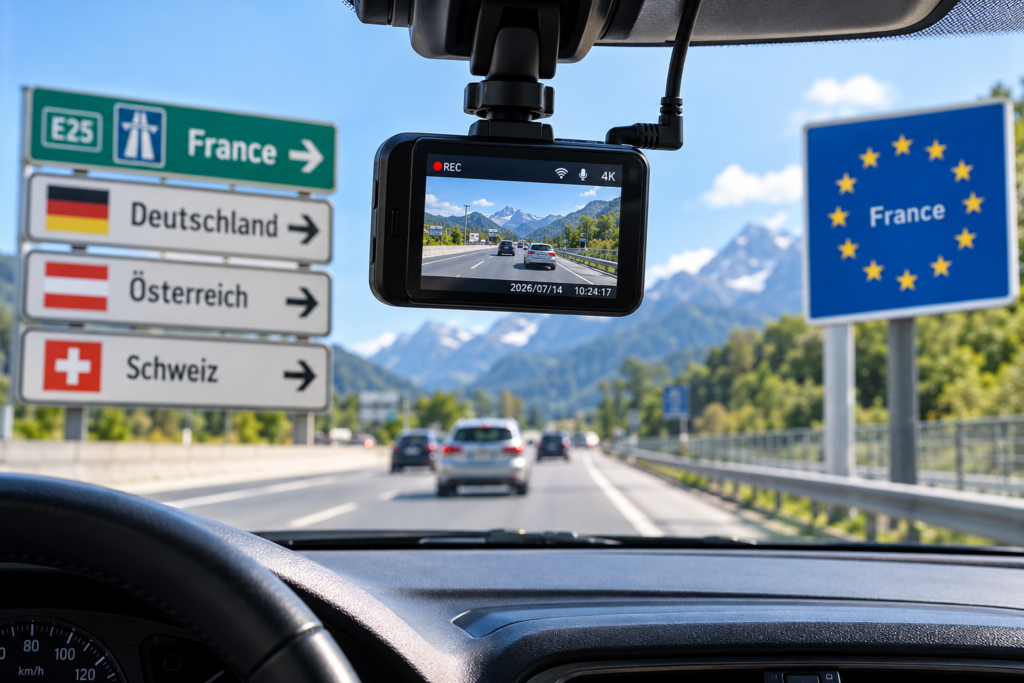
Dash cams are generally legal in the UK, but their use is more restricted in certain European countries. Some permit ordinary personal recordings, others place strict limits on continuous filming, and several have complicated data protection rules.
There is also a difference between owning a camera, recording a journey, keeping footage after an accident and uploading that footage to social media.
In this guide, we’ll explain the UK rules, compare the position in popular European driving destinations and look at what to check before taking your dash cam abroad.
Last legal information review: 31 October 2026. This guide provides general information rather than legal advice. National rules, regulatory guidance and court decisions can change, so check the latest requirements before travelling.
Are Dash Cams Legal in the UK?
Yes. Dash cams are generally legal to install and use in the UK. There is no general prohibition on private motorists recording their journeys with a dashboard camera.
That doesn’t mean you can mount one anywhere you like or use the footage however you please.
There are three main things to think about:
- Whether the camera obstructs your view of the road.
- Whether using it distracts you from driving.
- How you record, store and share footage containing identifiable people.
For most drivers, a compact camera fitted properly near the rear-view mirror is a practical solution.
However, the installation must be safe, and you remain responsible for maintaining a clear view of the road.
1. Where Can You Legally Mount a Dash Cam in the UK?
The camera shouldn’t significantly obstruct your view through the windscreen or interfere with your ability to drive safely.
Many drivers place a compact dash cam near the rear-view mirror, where it can capture the road without occupying much of the driver’s direct field of vision.
But the exact position matters.
You’ll sometimes see advice online claiming that dash cams are automatically legal if they’re less than 40mm in size or positioned within a particular distance from the windscreen edge.
That is an oversimplification.
The UK has windscreen obstruction and visibility requirements, including assessment zones used in MOT inspections. The familiar 10mm and 40mm figures are associated with particular windscreen visibility assessments, not a blanket permission to mount any dash cam of that size wherever you like.
What matters is whether the installation obstructs the driver’s view and complies with the relevant requirements.
Practical Installation Advice
- Choose a position that doesn’t interfere with your forward visibility.
- Avoid placing the camera directly in your normal line of sight.
- Make sure the mount is secure.
- Keep power cables away from steering controls and pedals.
- Never route wiring across an airbag deployment path.
- Check that any display doesn’t distract you while driving.
For official information, see the GOV.UK MOT visibility guidance.
2. Can You Use a Dash Cam Screen While Driving in the UK?
Many modern dash cams have a built-in screen showing a live view of the road, recording settings or previously saved footage.
It’s a convenient feature when you’re setting up the camera. But once you start driving, there are legal restrictions worth understanding.
In Great Britain, Regulation 109 of the Road Vehicles (Construction and Use) Regulations 1986 restricts certain screens and video displays visible to the driver, with exceptions for specific types of driving-related information.
So while owning a dash cam with a screen isn’t automatically a problem, what the screen displays and whether it falls within the law’s requirements can matter.
What Does Regulation 109 Actually Say?
Regulation 109 restricts driving when the driver can see, either directly or by reflection, a television receiving apparatus or other cinematographic apparatus displaying information outside certain permitted categories.
The regulation makes exceptions for information relating to:
- Vehicle condition: Information about the state of the vehicle or its equipment.
- Vehicle location: Information about the vehicle’s location and the road it is travelling on.
- Road visibility: Information assisting the driver in seeing the road adjacent to the vehicle.
- Navigation: Information helping the driver reach their destination.
These exceptions explain why certain navigation systems, reversing cameras and vehicle information displays can be used while driving.
However, they don’t provide unrestricted permission to watch recorded videos or unrelated content on a screen visible from the driver’s seat.
You can read the legislation directly in Regulation 109 of the Road Vehicles (Construction and Use) Regulations 1986.
Does This Mean a Dash Cam Live View Is Illegal?
Not necessarily. The legal position depends on the device, the information displayed and whether the particular display falls within the regulation and its exceptions.
For example, a camera view designed to help the driver see the road adjacent to the vehicle may fall within a permitted category.
However, you shouldn’t assume that every dash cam live preview is automatically exempt simply because it shows a road.
Likewise, watching previously recorded footage or browsing video clips while driving is not the same as using a driving assistance display.
For ordinary journey recording, a dash cam doesn’t generally need to keep its screen switched on. Many models can continue recording with the display off.
That is often the simplest option, particularly if the live preview isn’t needed for driving.
What About Changing Dash Cam Settings While Driving?
Even when a display falls within a permitted category, drivers must still maintain proper control of their vehicles and avoid distractions.
The Highway Code advises drivers not to become distracted by in-vehicle systems, including navigation and other electronic devices.
So if you need to adjust the resolution, connect your phone through WiFi, change parking mode settings or review a recording, do it when you’re safely parked.
Trying to change recording settings while negotiating a busy roundabout is hardly a sensible use of the technology.
See Highway Code Rules 149 and 150 for further guidance on distractions and in-vehicle technology.
Practical Advice for UK Drivers
If your dash cam has a built-in screen:
- Position the camera so it doesn’t obstruct your view of the road.
- Use an automatic screen-off or screen saver function where available.
- Avoid playing recorded footage on a screen visible to the driver while driving.
- Don’t interact with camera menus while the vehicle is moving.
- Check whether any live display you intend to use falls within the permitted driving-related categories.
- Remember that the camera can usually continue recording even when its display is switched off.
Our advice: If you don’t need to see the dash cam’s screen while driving, switch it off and let the camera record quietly in the background.
You’ll still have the footage when you need it, without an unnecessary distraction on the windscreen.
Legal reference: The Road Vehicles (Construction and Use) Regulations 1986, Regulation 109, applicable in Great Britain. Northern Ireland has separate road traffic legislation, so drivers should check the relevant local requirements.
3. Can Dash Cam Footage Be Used as Evidence in the UK?
Yes. Dash cam footage can be useful when investigating road traffic incidents, insurance claims and certain driving offences.
For example, imagine another driver changes lanes into your vehicle and later claims you were the one who moved across.
A recording may help establish the position of the vehicles before the collision.
It might also capture road markings, traffic signals or the sequence of events leading up to an accident.
However, a dash cam recording doesn’t automatically prove who was legally responsible.
The quality, relevance, completeness and authenticity of the footage all matter.
Can You Send Dash Cam Footage to the Police?
Yes. Police forces across the UK accept relevant video evidence of certain driving offences through reporting systems, including Operation Snap schemes.
These allow members of the public to submit footage of potentially dangerous or careless driving for assessment.
Submission procedures and time limits vary by police force, so check the requirements for the area where the incident occurred.
Keep the original recording where possible, preserve the date and time information and avoid editing the footage in ways that could affect its evidential value.
It’s also wise to retain footage showing the context before and after an incident, rather than only a few seconds that might give an incomplete impression.
4. Is It Legal to Post Dash Cam Footage Online in the UK?
This is where things become more complicated.
Recording a journey for purely personal purposes is not necessarily treated in the same way as publishing identifiable footage online.
The UK Information Commissioner’s Office (ICO) explains that personal dash cam recordings made as part of an individual’s own driving activity can fall within the personal or household exemption.
However, publishing footage containing identifiable people online can take that processing outside the personal exemption and bring UK data protection rules into play.
For example, posting a video of another driver with their face and registration visible, accompanied by accusations about their behaviour, raises different concerns from privately saving the same footage after an accident.
Before Sharing a Dash Cam Video
- Consider whether the footage identifies individuals.
- Avoid making unnecessary public accusations.
- Consider anonymising faces and registration numbers where appropriate.
- Remember that audio may contain private conversations.
- Keep incident evidence secure.
- Use appropriate police or insurance reporting channels when relevant.
Blurring a registration number doesn’t automatically resolve every privacy issue. Someone might still be identifiable from their appearance, vehicle or surrounding circumstances.
For more information, read the ICO guidance on consumer connected devices and dash cam recordings.
5. Are Dash Cams Legal in Europe?
There isn’t one simple European rule covering dash cams in every country.
Although the General Data Protection Regulation (GDPR) provides a shared framework across the European Union, national laws, regulatory interpretations and court decisions can differ.
That means a particular recording practice might be acceptable in one country but legally problematic in another.
And it’s important to remember that the rules concern more than the physical camera.
A country’s approach may depend on whether you are recording continuously, how long footage is stored, whether identifiable people are captured and what you do with recordings afterwards.
The following table summarises the position in several popular European driving destinations.
Dash Cam Laws by Country: Europe Comparison Table
Information reviewed 31 October 2026. These summaries are not blanket permissions to record. Check the linked national guidance before travelling, especially when crossing multiple borders.
| Country | General Position | What UK Drivers Should Know |
|---|---|---|
| United Kingdom | Generally permitted | Keep the driver’s view clear and follow privacy rules when using or publishing footage. |
| France | Generally permitted with conditions | Install safely and respect privacy and data protection requirements, particularly when sharing recordings. |
| Belgium | Permitted subject to privacy rules | Personal use is generally possible, but publication and other uses of recordings require care. |
| Netherlands | Not prohibited for private use | Personal data, registration numbers, surveillance purpose and public sharing can create GDPR obligations. |
| Germany | Restricted use | Continuous, indiscriminate storage is problematic. Short, event-related recording is generally preferable. |
| Austria | Strictly restricted | Ordinary wide-angle continuous recording often fails data protection requirements. Individual exceptions may exist. |
| Luxembourg | Strictly restricted | Recording identifiable people on public roads raises serious GDPR concerns. Limited event recording may be assessed differently. |
| Switzerland | Privacy-sensitive; check current rules | General data protection principles apply to identifiable recordings. Do not assume continuous filming is unrestricted. |
| Spain | Personal recording may be permitted | Strictly personal use may fall under an exemption, while publication and other processing can trigger data protection obligations. |
| Italy | Generally permitted with conditions | Observe privacy, road safety and recording-use requirements. |
| Portugal | Legally complex; exercise caution | Public-road recording raises privacy issues. The legality of particular recordings depends on their purpose and circumstances. |
| Poland | Generally permitted for personal use | Sharing identifiable footage publicly requires additional care. |
| Ireland | Permitted subject to data protection considerations | Recording identifiable people and passengers, especially with audio, may create privacy obligations. |
This table deliberately distinguishes restricted use from an outright ban. In several countries, describing all dash cams as either completely legal or completely illegal would be misleading.
For destinations not listed here, check the relevant national transport and data protection authorities before using your camera.
6. Are Dash Cams Legal in France?
Dash cams are generally permitted in France, but drivers must respect road safety and privacy requirements.
A camera should not obstruct the driver’s view or interfere with safe operation of the vehicle.
As in the UK, recording footage privately and publishing identifiable recordings online are different activities.
Privacy rights and data protection rules can become relevant when footage contains identifiable people or is used beyond a strictly personal context.
France’s data protection authority, the CNIL, has also been examining the broader issues associated with connected vehicles and onboard cameras.
For UK drivers travelling through France, the practical approach is to use a discreet, securely mounted camera and avoid unnecessarily publishing identifiable footage.
If you’re only travelling through France on your way to another country, remember to check the rules at your final destination and everywhere you pass through.
You can follow developments through France’s CNIL guidance concerning connected vehicles.
7. Are Dash Cams Legal in Germany?
Germany takes data protection seriously, and dash cams are a good example of why the details matter.
Owning and installing a dash cam is not generally prohibited, but continuously recording and retaining ordinary road traffic footage without a specific reason can conflict with data protection law.
The German motoring organisation ADAC explains that short, event-related recordings are more consistent with data protection requirements than extensive indiscriminate storage.
For example, a camera that continually overwrites temporary footage and permanently saves a short recording when an accident is detected may be more appropriate than one that keeps every minute of every journey indefinitely.
Can Dash Cam Footage Be Used in a German Court?
Potentially, yes.
Germany’s Federal Court of Justice has accepted that dash cam footage can be considered as evidence in certain civil accident cases, subject to an assessment of the competing interests.
However, the fact that footage may be admissible as evidence does not automatically mean the way it was recorded complied with data protection rules.
Those are separate questions.
This distinction is particularly important if you’re planning to drive through Germany with a dash cam that automatically saves long, continuous recordings.
Read the ADAC guide to dash cams in Germany for further information.
8. Are Dash Cams Illegal in Austria?
Austria is one of the countries where UK drivers should be particularly cautious.
You’ll often see the simple statement that dash cams are banned in Austria.
The actual position is more nuanced, although it remains restrictive.
Austria’s data protection authority explains that dash cams are generally problematic because typical recording configurations capture wide areas and retain footage in ways that interfere with other road users’ privacy rights.
However, it also states that dash cams are not completely prohibited in every possible situation. Legality must be assessed according to the purpose, scope and circumstances of the recording.
Relevant factors can include:
- Why the footage is being recorded.
- Whether recording is limited to an incident.
- The area captured by the camera.
- How long recordings are retained.
- Whether footage is securely stored.
- How any saved material is subsequently used.
Practical advice: Don’t assume that the normal continuous-recording settings you use in the UK are acceptable in Austria.
Check the latest requirements before your journey. If you cannot establish that your intended recording setup is compliant, disabling recording while in Austria is the cautious approach.
See the Austrian Data Protection Authority’s dash cam guidance.
9. Are Dash Cams Legal in Luxembourg?
Luxembourg is another country where the issue is more complicated than a simple yes or no.
Its data protection authority, the CNPD, has taken a strict approach to dash cams recording identifiable people on public roads.
The authority explains that such recordings can fall within GDPR requirements and that it can be difficult to establish a lawful basis for routine surveillance.
However, the CNPD has also discussed circumstances where legitimate interests might justify very short recordings associated with particular events.
For example, limited recordings lasting only a few minutes may be assessed differently from continuous filming and long-term storage of ordinary traffic.
That doesn’t amount to a blanket authorisation for all event-based cameras.
For UK drivers passing through Luxembourg, especially on longer European journeys, it’s sensible to review the latest regulator guidance before allowing the camera to record.
Read the Luxembourg CNPD guidance on dash cams.
10. What About Switzerland?
Switzerland is not part of the European Union, and its data protection framework is separate from the EU GDPR.
Nevertheless, Swiss data protection rules also place importance on transparency, proportionality and the handling of information about identifiable people.
Continuous recording of members of the public can therefore raise privacy concerns.
Rather than relying on a general claim that dash cams are either freely permitted or completely banned, check the current guidance for the type of recording you intend to carry out.
This is especially relevant if you’re travelling through Switzerland on a European driving holiday and intend to retain recordings of the entire journey.
The Swiss Federal Data Protection and Information Commissioner is an appropriate starting point for national privacy information.
11. Are Dash Cams Legal in Spain and Portugal?
Spain
Spain’s data protection authority, the AEPD, recognises that recording journeys for strictly personal or household purposes may fall outside the ordinary application of data protection rules.
However, if footage is published online or used for another purpose, the legal position changes.
In particular, recording identifiable people and sharing their images may create data protection obligations.
Spain also distinguishes between purely personal recordings and recordings made for surveillance or evidential purposes.
You can read the AEPD guidance on recording private journeys.
Portugal
Portugal has a more legally complicated position concerning dash cams and the filming of public areas.
Portuguese data protection and privacy rules can raise concerns when recording identifiable people or vehicles on public roads.
However, the position should not be reduced to a claim that every dash cam recording is automatically unlawful in every circumstance.
Legal commentary published by the Portuguese automobile club ACP in May 2026 discusses court decisions concerning vehicle protection and the circumstances in which recordings may be justified.
Because the outcome can depend on the purpose and scope of recording, it’s important to seek up-to-date guidance before using your camera in Portugal.
See the ACP explanation of dash cam legality in Portugal.
12. What About Belgium and the Netherlands?
Both countries permit certain forms of private dash cam use, but data protection rules remain important.
Belgium
Belgian police guidance explains that dash cams are not generally prohibited in vehicles.
However, the use and publication of recordings must respect privacy legislation.
For example, sharing identifiable footage publicly is not treated in the same way as keeping a private recording of a journey.
See the Belgian police guidance on dash cams.
Netherlands
Dutch police guidance confirms that installing a dash cam for private use is not prohibited.
However, footage containing identifiable people or vehicle registration numbers may constitute personal data.
The Dutch authorities also emphasise the importance of limiting unnecessary recording of public roads when using cameras for vehicle security.
Publishing footage that identifies people can raise additional legal issues.
Read the Netherlands Police guidance on vehicle cameras.
13. Are Dash Cams Legal in Italy, Poland and Ireland?
Italy
Dash cams are generally permitted in Italy, subject to applicable road safety, privacy and data protection requirements.
Personal recording is not the same as unrestricted public distribution of footage.
Take particular care when publishing videos containing identifiable people or registration numbers.
Poland
Dash cams are widely used and generally permitted for personal recording in Poland.
Footage can be useful when documenting road incidents, but publishing identifiable recordings online raises separate privacy and personal rights considerations.
As elsewhere, the fact that you recorded something on a public road doesn’t automatically give you unrestricted permission to publish it.
Ireland
Ireland’s Data Protection Commission has published specific guidance for drivers using dash cams.
It explains that data protection considerations can arise depending on the nature of the recording, the people captured and the purpose for which footage is used.
Audio recording is a particular concern when private conversations involving passengers are captured.
If you’re taking your car from Great Britain to Ireland, check the camera’s recording and audio settings and consider how footage will be used.
See the Irish Data Protection Commission’s guidance for drivers.
14. Can You Record an Entire Road Trip Across Europe?
Not necessarily without restrictions.
Suppose you’re planning a summer road trip from the UK through France, Belgium, Luxembourg, Germany and Austria.
Your dash cam might be configured to record every minute of the journey and keep the files until the memory card becomes full.
That arrangement may be acceptable for ordinary personal driving in some countries, but it can be problematic in places with stricter rules on continuous recording of public roads.
Switching from one country to another doesn’t change the camera’s settings automatically.
That’s something you’ll need to consider before crossing a border.
Before Travelling, Check:
- Whether the destination permits your type of dash cam recording.
- Whether continuous recording is restricted.
- Whether event-triggered recording is treated differently.
- Whether audio recording is appropriate.
- How long footage may be retained.
- Whether the camera’s position meets local visibility requirements.
- Whether local rules apply to publication or sharing.
It’s also sensible to check the countries you’ll only be passing through, not just your final destination.
The EU Your Europe road rules information provides country-specific driving resources, although dash cam privacy requirements may need checking separately with national authorities.
15. Is Parking Mode Legal When Driving Abroad?
Parking mode adds another layer of complexity.
Some dash cams record only after detecting an impact. Others monitor motion, use time-lapse recording or continuously record the area around a parked vehicle.
From a privacy perspective, those modes can operate differently.
For example, a camera continuously filming a public pavement throughout the night may raise questions that don’t arise in the same way with a short recording triggered by a particular incident.
Local law, camera positioning, the area recorded and the purpose of surveillance all matter.
Don’t assume that a parking feature permitted in the UK is automatically acceptable elsewhere.
For more information about the technology itself, read our Dash Cam Parking Mode Explained guide.
If you’re choosing a camera specifically to monitor your vehicle while parked, our Dash Cam for Parking Protection guide explains the practical differences between recording modes.
16. Is Audio Recording Legal on a Dash Cam?
Audio recording deserves particular attention because it can capture private conversations rather than just road activity.
Some dash cams record sound through a built-in microphone unless the feature is disabled.
That might include conversations between family members, passengers or colleagues.
Whether audio recording is lawful depends on the jurisdiction, purpose and circumstances.
For commercial vehicles and workplace monitoring, privacy requirements can be particularly important.
In the UK, the ICO advises organisations that use vehicle monitoring systems to treat audio recording as a higher-risk feature and to switch it off by default unless there is a justified reason to use it.
If you don’t need sound for a specific purpose, disabling audio recording may be a sensible privacy precaution, particularly when travelling abroad.
17. Can You Use a Dash Cam in a Company Car or Taxi?
Potentially, but the legal requirements may be different from those affecting purely personal use.
A private individual recording an ordinary journey may fall within a personal-use exemption in certain circumstances.
A business using cameras to monitor employees, passengers, vehicles or commercial operations is in a different position.
In the UK, the ICO explains that work-related dash cam use may require compliance with data protection rules and, depending on the circumstances, registration and payment of a data protection fee.
Businesses may also need to address transparency, retention periods, appropriate access controls and the lawful purpose of recording.
See the ICO registration guidance for work-related dash cam use.
18. What Should You Do With Dash Cam Footage After an Accident Abroad?
If an incident occurs while you’re driving in another country, your immediate priority should always be safety.
Follow local requirements concerning emergency assistance, accident reporting and exchanging information.
Once it’s safe to do so, consider the following steps:
- Preserve the original recording if one exists.
- Avoid altering or deleting relevant footage.
- Record the date, location and circumstances of the incident.
- Follow the applicable local police reporting procedures.
- Contact your insurer where necessary.
- Check how the footage may lawfully be provided or used in that country.
- Avoid publishing the recording publicly while the incident is being dealt with.
Remember that footage being potentially useful as evidence doesn’t necessarily mean the original recording process complied with every applicable privacy requirement.
If the incident is serious or legally disputed, seek appropriate advice under the law of the country concerned.
19. What Dash Cam Features Are Useful for Driving Abroad?
Legal considerations aside, several features can make a dash cam easier to use on longer journeys.
| Feature | Why It May Be Useful |
|---|---|
| Compact Design | Easier to position without obstructing visibility |
| Loop Recording | Automatically replaces older unprotected footage |
| Event Recording | Can preserve short clips associated with incidents |
| Adjustable Recording Settings | Allows recording behaviour to be adapted where appropriate |
| Audio On/Off | Provides control over passenger conversation recording |
| WiFi Connectivity | Can make retrieving recordings easier without removing the card |
| GPS | May provide location and route information |
| Front and Rear Recording | Provides additional viewpoints of certain incidents |
| Suitable Memory Card | Supports reliable recording during long journeys |
Of course, the fact that a camera offers a particular recording feature does not mean its use is lawful in every country.
For example, event-triggered recording may be more appropriate in certain jurisdictions, but you’ll still need to check the relevant national requirements.
For a general introduction, see our Dash Cam Buying Guide UK.
20. Dash Cam Checklist Before Driving to Europe
Before setting off, it’s worth checking the following:
- Have I checked the dash cam rules in every country on my route?
- Does the camera obstruct my view?
- Can I disable continuous recording if necessary?
- Does the camera support short event recordings?
- Can audio recording be switched off?
- Do I know how to stop recording safely?
- Are important files protected and stored securely?
- Do I understand the rules on publishing footage?
- Does my camera use a suitable memory card?
- Have I checked that my power supply and mount are secure?
- Do I know how to preserve original footage after an incident?
- Have I checked the latest official guidance before travelling?
It may sound like a lot of preparation for a small camera.
But checking the rules before leaving home is considerably easier than trying to understand another country’s data protection system after an incident on holiday.
Frequently Asked Questions About Dash Cam Laws
Are dash cams legal in the UK?
Yes. Dash cams are generally legal in the UK when installed and used safely. The camera must not significantly obstruct the driver’s view, and the use or publication of identifiable footage can raise privacy and data protection issues.
Are dash cams legal throughout Europe?
No single rule applies across all European countries. Some generally permit personal use, while others impose strict conditions on recording public roads or retaining footage. Check the laws and regulatory guidance for each country before travelling.
Are dash cams banned in Austria?
Austria applies strict data protection rules, and ordinary continuous recording configurations are generally problematic. However, its data protection authority does not describe every possible dash cam use as automatically unlawful. Compliance depends on the particular circumstances.
Can I use a dash cam in Germany?
Germany does not generally prohibit owning or installing a dash cam, but continuous indiscriminate recording and storage can breach data protection requirements. Short event-related recordings are generally a more appropriate approach, subject to the applicable rules.
Are dash cams illegal in Luxembourg?
Luxembourg takes a restrictive approach to filming identifiable people on public roads. Its data protection authority recognises that some very limited event recordings may require a different assessment, but routine public-road recording raises significant GDPR concerns.
Can I use a dash cam in France?
Dash cams are generally permitted in France, subject to road safety and privacy requirements. Drivers should ensure their camera is safely positioned and treat publication of identifiable footage with care.
Are dash cams legal in Portugal?
The legal position is complex. Filming public areas can raise data protection and privacy concerns, although some court decisions have considered circumstances where recording for vehicle protection may be justified. Check current Portuguese guidance before using one.
Can I drive through Europe with my dash cam switched off?
Switching off recording can avoid some concerns associated with collecting footage, but you should still check any local requirements concerning the installation and use of devices in vehicles. The rules on possessing equipment and recording with it are not necessarily identical.
Can dash cam footage be used in court?
Potentially, depending on the country, the type of proceedings and the circumstances. The fact that footage may be considered as evidence does not automatically make every recording method lawful.
Can I upload a dash cam accident video to YouTube or Facebook?
Publishing identifiable footage may create privacy, data protection and other legal issues. Consider whether identifiable people, registration numbers or private conversations are involved and whether you have an appropriate lawful basis for publication.
Do I need to tell passengers my dash cam is recording?
That depends on the circumstances and applicable law. Passenger-facing video and audio recording can raise additional privacy concerns, especially in work-related vehicles. Being transparent and avoiding unnecessary audio recording are sensible precautions.
Does GDPR apply to dash cams?
It can. The GDPR may apply when identifiable personal data is processed outside a purely personal or household context. The precise application depends on the country, the recording activity and how footage is used.
Can I submit dash cam footage to the UK police?
Yes. UK police forces have procedures for receiving relevant footage of road incidents and certain offences. Check the reporting process and time limits for the appropriate police force.
Should I disable parking mode when abroad?
That depends on the applicable national rules. In countries with strict privacy requirements concerning recording public spaces, continuous parking surveillance may be problematic. Check local guidance before using the feature.
Explore More Dash Cam Buying Guides
Understanding the legal rules is part of using a dash cam responsibly. If you’re still choosing a camera or learning how its features work, the rest of our Knowledge Hub series covers the practical details.
- Dash Cam Buying Guide UK: How to Choose the Right Dash Cam
- Front vs Front and Rear Dash Cam: Is a Rear Camera Worth It?
- Do Dash Cams Record When the Car Is Off? Parking Mode Explained
- Wireless Dash Cams Explained: WiFi, Power Cables and Installation
- 1080p vs 2K vs 4K Dash Cams: Is 4K Really Worth It?
- Dash Cam Without Hardwiring: How Can You Power It?
- Dash Cam for Parking Protection: What Features Do You Need?
- What SD Card Do You Need for a Dash Cam?
Final Thoughts: Can You Take Your Dash Cam Abroad?
In many cases, yes. But taking a camera abroad and being allowed to record everything with it are two different things.
In the UK, dash cams are generally straightforward to use when properly installed. Across Europe, the rules become more varied.
Germany places important restrictions on unnecessary continuous recording. Austria and Luxembourg take particularly strict approaches to privacy. Other countries allow various forms of personal recording but impose conditions on how footage is handled and shared.
That’s why we wouldn’t recommend assuming that one camera setting is suitable for every country.
Our advice: Before travelling, check the rules for your complete route, not just your destination. Keep the camera safely positioned, minimise unnecessary recording and treat identifiable footage responsibly.
A dash cam can be useful when something goes wrong on the road. It should help you document an incident, not create a new legal problem on top of it.
And while preparing for European road rules might not be the most exciting part of planning a holiday, it’s probably preferable to discussing your camera settings with the authorities in a language you barely remember from school.
Looking for a suitable camera? Browse the PYC Online Dashcam collection to explore available recording features, camera configurations and installation options.
For more straightforward advice on car technology and buying decisions, visit our Knowledge Hub.
Legal information last reviewed: 31 October 2026. This article is intended for general information. National law, regulatory interpretation and court decisions may change. Always consult the relevant official authority before travelling.
Leave a comment