
Can You Replace an Existing Wall Socket with a Power Track System?
Replacing a traditional wall socket with a power track system is an idea many homeowners consider when renovating a kitchen, updating a home office or looking for more flexible access to electricity.
Instead of having two fixed outlets in one position, a power track uses a rail with compatible socket adapters that can be positioned at different points along its length. This can make it easier to arrange appliances and adapt the space when your requirements change.
But can you replace an existing wall socket with a power track system? In some cases, yes. However, it depends on the type of power track, the existing electrical circuit and the manufacturer’s installation requirements. Some systems are designed to use an existing connection point, while others require a separate circuit.
This guide explains the available installation options, what happens to your original wall socket and the important details to check before purchasing a power track system in the UK.
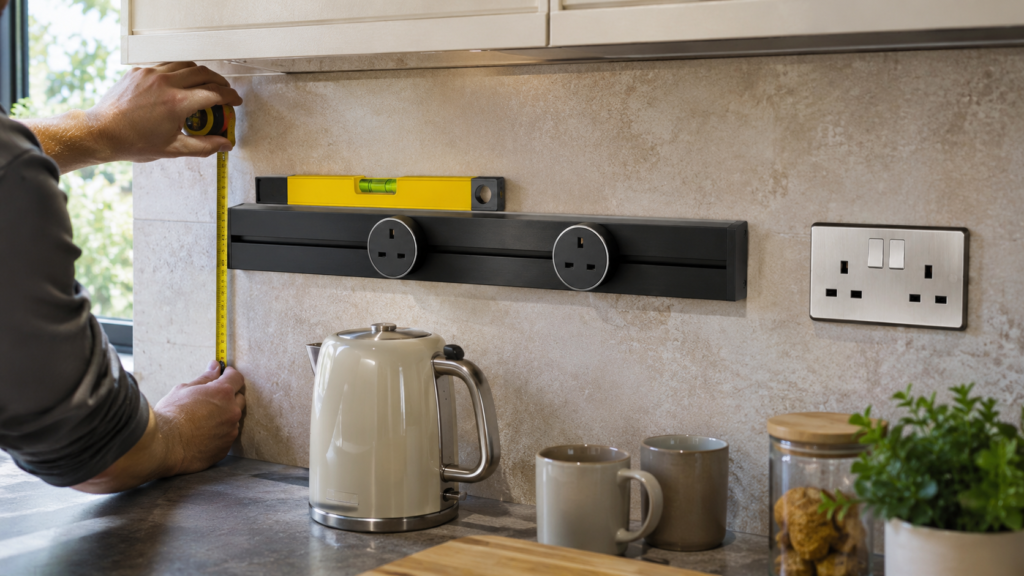
Can You Replace a Wall Socket with a Power Track?
It may be possible to install a suitable power track in place of a conventional socket, but the change is not necessarily a straightforward socket-for-socket replacement.
A standard UK wall socket is an electrical accessory connected to the property’s wiring. A power track is a different type of system that distributes electricity along a rail and uses compatible removable outlet modules.
Although both provide places to connect appliances, their installation and electrical requirements can be different.
For example, some manufacturers offer track systems designed to make use of an existing electrical connection. Other manufacturers specifically require a new dedicated circuit.
SAGA PowerTrack, for instance, states that its hardwired systems require a separate supply and should not be extended from an existing socket point.
This is why the first step should be choosing the correct system and reviewing its installation requirements, rather than assuming it can simply be connected to the wires behind your current socket.
How Is a Power Track Different from a Traditional Wall Socket?
Traditional wall sockets provide fixed connection points. Once installed, their position and number remain the same unless the electrical installation is altered.
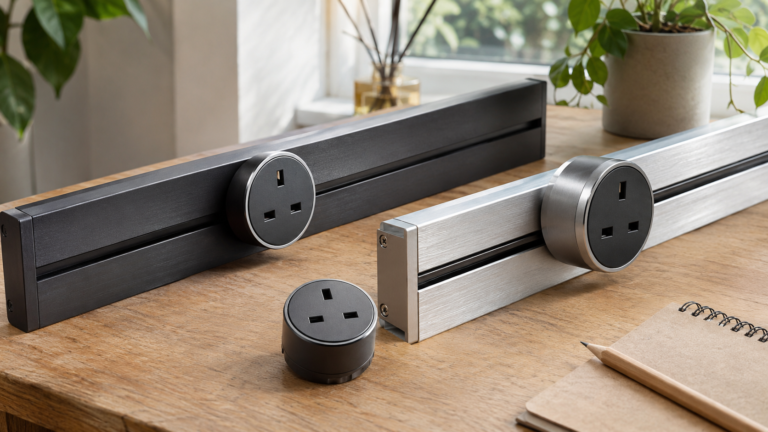
A power track system normally consists of a mounted rail and compatible adapters. Depending on the design, these adapters can be added, removed or repositioned along the rail.
This can be useful in areas where the arrangement of appliances changes regularly, such as kitchen worktops and home offices.
| Feature | Traditional Wall Socket | Power Track System |
|---|---|---|
| Outlet position | Fixed | Adjustable along the compatible rail |
| Additional outlets | Usually requires further installation work | May accept additional compatible adapters |
| Installation | Conventional electrical accessory | System-specific mounting and supply requirements |
| Appearance | Individual wall plates | Continuous rail with removable modules |
| Flexibility | Limited without rewiring | Greater positioning flexibility within the installed system |
If you are unfamiliar with modular socket systems, our Power Track Socket Systems UK buying guide explains the different components and how they work together.
Three Types of Power Track Installation
Not every power track is installed in the same way. Understanding the differences will help you choose a suitable system before arranging any electrical work.
1. Surface-Mounted Power Tracks
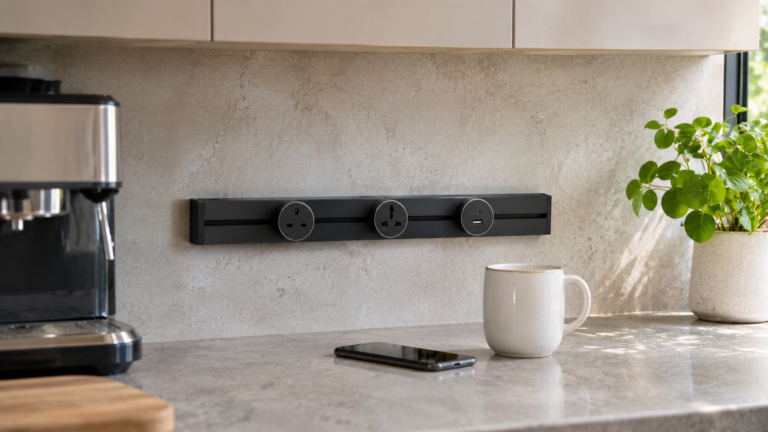
A surface-mounted power track is fitted onto a suitable finished surface, such as a wall, approved panel or kitchen backsplash.
Unlike a recessed system, the rail itself does not normally require a long opening to be cut into the mounting surface.
This makes surface-mounted tracks particularly interesting for existing kitchens and home offices where major renovation work is not planned.
However, the electrical supply still needs to reach the track. Depending on the manufacturer’s design and the existing installation, the cable may need to be routed through the wall or through an appropriate surface-mounted arrangement.
Surface mounting therefore does not automatically mean installation without electrical work.
2. Recessed Power Tracks
A recessed power track is designed to sit partly or almost completely within a prepared opening.
These systems can produce a more integrated appearance because less of the rail projects beyond the surrounding surface.
They are often considered during kitchen renovations, furniture manufacturing or the installation of new worktops and wall panels.
However, the opening must match the exact dimensions specified by the manufacturer. Recessed systems generally require more preparation than surface-mounted alternatives.
They are best planned before the surrounding surfaces are finished.
3. Plug-In or Portable Power Track Systems
Some modular power systems are specifically designed to receive electricity through a suitable plug-in connection rather than being permanently wired into the building.
These may be used as portable or furniture-mounted power solutions, depending on the product.
However, a permanently wired power track should never be converted into a plug-in system unless the manufacturer specifically approves that arrangement.
A plug-in system also remains subject to the limits of the socket and electrical circuit supplying it.
Always confirm whether the particular product is intended for plug-in operation, fixed installation or another approved connection method.
Can You Connect a Power Track to an Existing Double Socket?
This is one of the most important questions to resolve before buying.
If you have a double wall socket in the position where you would like to install a power track, you may wonder whether the existing electrical connection can be reused.
The answer depends on both the chosen track and the existing electrical installation.
Some systems may permit a suitable existing point to be used as part of their approved installation arrangement. Others require a completely separate circuit from the consumer unit.
The electrician will need to consider the type and condition of the existing circuit, the protective devices, the track manufacturer’s requirements and the expected electrical load.
Simply having two available socket outlets does not mean that the circuit has spare capacity for additional high-power appliances.
Similarly, a rail advertised with a high current rating does not automatically allow that full rating to be used with an existing socket circuit.
Important: Do not assume that a power track can be connected directly to the wires behind a double socket. Have the exact product and installation assessed before any changes are made.
What Happens to the Old Socket When You Install a Power Track?
If a power track is intended to occupy the area where a conventional socket is currently fitted, the electrician must decide what should happen to the original accessory and wiring.
Depending on the installation, the original connection may be retained, altered, relocated or appropriately disconnected.
In some projects, homeowners prefer to keep the existing wall socket and install a separate power track nearby.
This can be useful because conventional sockets remain available for devices that do not need a movable outlet.
Can you cover the original socket with the power track?
You should not simply cover an existing socket or electrical connection with a rail for appearance purposes.
Any redundant or altered wiring must be dealt with correctly, and connections must comply with the relevant requirements for the installation.
The track should not be used to conceal an unsuitable, damaged or incorrectly terminated connection.
Ask your electrician whether the old connection can be safely removed, relocated or retained in an appropriate enclosure.
Does a Surface-Mounted Power Track Require Wall Chasing?
Not necessarily.
Wall chasing involves cutting a channel into a wall to accommodate electrical cables or equipment.
A surface-mounted power track is designed to sit on the finished mounting surface, so the rail itself may not require a long recessed channel.
However, the supply cable still needs an appropriate route.
If a new circuit is required, additional electrical work may be necessary even when the rail is surface-mounted.
The final arrangement depends on the product, the wall construction, the location of the supply and the electrician’s assessment.
Can You Install a Power Track on Kitchen Tiles?
A tiled kitchen backsplash can be a possible mounting location for a suitable surface-mounted power track.
The key considerations are the manufacturer’s approved mounting method, the condition of the tiles, the underlying wall and the available installation space.
A track must be securely mounted according to its installation instructions.
Can you install a power track without drilling?
Not every system supports a no-drill installation.
Some products may use manufacturer-approved alternative mounting arrangements, but others require mechanical fixings such as screws and brackets.
Do not assume that ordinary double-sided tape or general-purpose adhesive is suitable for supporting an electrical power rail.
Even where an approved no-drill mounting method exists, the electrical supply requirements still need to be addressed separately.
What if you have a glass backsplash?
Glass backsplashes require particular care because drilling or altering an installed glass panel may be unsuitable or impossible.
If you have a glass splashback, check the proposed mounting arrangement with the track manufacturer and an appropriate installer before purchasing.
It may be more practical to choose another mounting position rather than modify the glass.
Can You Install a Power Track Under Kitchen Cabinets?
Under-cabinet mounting may be an option for certain systems, but it should not be assumed to be suitable for every power rail.
Some tracks have specific permitted mounting orientations. Others may require particular access, clearance or support arrangements.
Before choosing an under-cabinet location, consider:
- Whether the manufacturer permits that mounting orientation.
- Whether adapters can be fitted and removed comfortably.
- The clearance required for plugs and charging cables.
- The cabinet material and its suitability for mounting.
- The distance from sinks, cooking areas and other sources of heat or moisture.
- How the supply cable will be routed.
Remember that a track mounted under a cabinet will still have electrical and physical installation requirements.
How Close Can a Power Track Be to a Kitchen Sink?
The location should be selected carefully because kitchens combine electrical equipment with water, heat and frequently used appliances.
Electrical Safety First recommends that socket outlets and switches should be fitted at a safe distance from sinks, preferably at least 30 cm horizontally where possible.
The manufacturer’s requirements may also restrict where a particular track can be installed.
For example, a product intended only for dry indoor use should not be placed where it is exposed to splashes or unsuitable moisture conditions.
Do not position a power track directly behind a sink or in a location where water is likely to reach the electrical connections.
For further guidance, see Electrical Safety First’s kitchen safety advice.
Can You Cut a Power Track Rail to the Exact Length?
Not all power track systems can be shortened.
Some manufacturers supply rails in fixed lengths that must not be cut. Others may offer specific models designed for approved shortening or custom-sized installation.
Cutting an unsuitable rail could damage its internal conductors, insulation, end connections or other protective components.
For example, SAGA specifies factory lengths for its surface-mounted tracks and states that these products must not be cut on site.
This does not establish the requirements of other manufacturers, so always consult the instructions for the exact rail model.
Before ordering, measure the available wall space and check the overall dimensions, mounting clearances and usable adapter positions.
Can a Power Track Replace Several Wall Sockets?
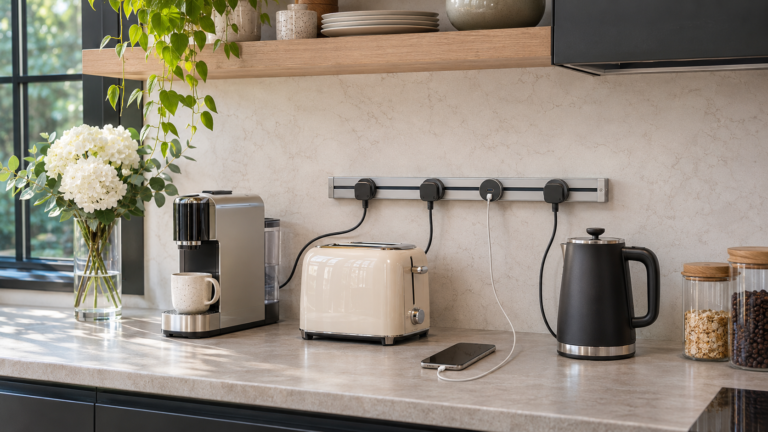
A power track may provide several flexible connection points along one rail, which can make it an attractive alternative to installing a row of fixed sockets in certain locations.
However, the number of adapters that fit onto a rail is not the same as the number of appliances that can safely operate at once.
Every electrical system has limits determined by its design, adapters, supply circuit and protective arrangements.
For example, placing several adapters along one track does not automatically provide the capacity of several independent electrical circuits.
If you intend to connect high-power appliances such as kettles, toasters, microwaves or air fryers, ask an electrician to check whether the proposed system is suitable for the expected combination of loads.
Some appliances may be better served by their existing dedicated or fixed connection arrangements.
For general room planning, our How Many Sockets Should a Room Have? guide explains how to think about outlet numbers and positioning.
What Should You Check Before Ordering a Power Track?
Planning the installation before buying can help prevent ordering a rail that does not fit the available space or cannot be used with the existing electrical arrangement.
1. Confirm the installation type
Check whether the selected track is surface-mounted, recessed, plug-in or designed for another specific arrangement.
2. Check the manufacturer’s electrical requirements
Find out whether the system requires a dedicated circuit or permits another approved supply arrangement.
3. Measure the available space
Consider the rail’s full dimensions, end clearances, mounting points and the space needed for connected plugs.
4. Check the wall or mounting surface
Tiles, plasterboard, solid masonry, glass and furniture panels can have different mounting requirements.
5. Identify the required socket adapters
Choose modules suitable for the intended appliances and confirm that they are compatible with the exact rail.
Read our Power Track Socket Adapter Compatibility Guide before buying additional modules.
6. Confirm what is included in the selected variation
Some product listings offer separate options for rail lengths and adapter modules.
Do not assume that selecting a rail automatically includes several socket adapters unless the listing explicitly confirms the contents.
7. Discuss the proposed installation with an electrician
For fixed electrical installations, a qualified electrician can assess the existing circuit, the proposed location, the manufacturer’s instructions and any necessary testing or certification.
Electrical Safety First recommends using a registered electrician for electrical installation work.
Common Power Track Installation Mistakes
Several avoidable mistakes can make a power track project more complicated than expected.
- Assuming every power track uses an existing socket: some systems require their own dedicated electrical circuit.
- Choosing the rail before checking the installation: the available supply and mounting arrangement may influence which product is suitable.
- Ignoring plug clearance: a rail may fit on the wall while connected adapters interfere with cupboards or worktops.
- Assuming surface mounting means no electrical work: the rail still requires a suitable power supply.
- Using unsuitable mounting methods: electrical equipment must be fitted according to the manufacturer’s instructions.
- Cutting a fixed-length rail: not all tracks are designed to be shortened.
- Buying the wrong adapter: similarly designed socket modules may not be compatible.
- Confusing the rail rating with circuit capacity: the electrical supply may impose a lower limit.
You may also find our Common Mistakes When Buying Sockets and Switches guide useful when planning a renovation.
Frequently Asked Questions
Can I replace a double wall socket with a power track?
Potentially, but the suitability depends on the exact track, the existing electrical installation and the manufacturer’s requirements. Some systems permit particular existing connections, while others require a new circuit. A qualified electrician should assess the proposed replacement.
Do I need an electrician to install a power track?
For a hardwired power track, electrical installation should be carried out by a qualified electrician. A purpose-designed plug-in system has different requirements, but it must still be used and mounted according to its instructions.
Can I install a power track without removing the old socket?
In some arrangements, the existing socket can remain in place while a separate track is installed nearby. Whether this is appropriate depends on the available space, electrical supply and installation design.
Do power track sockets require new wiring?
Some installations require a new circuit, while others may use an approved existing supply arrangement. Do not assume that an existing wall socket can power any track model.
Can I install a power track directly over an old socket box?
Not automatically. The existing wiring, enclosure, access requirements and track mounting arrangement must be assessed. A track should not simply be used to cover an existing electrical connection.
Can I put a power track on kitchen tiles?
Some surface-mounted systems may be suitable for tiled walls when installed using the manufacturer’s approved fixing method. The suitability of the wall, tiles and supply arrangement must be checked first.
Can I install a power track without cutting into the wall?
A surface-mounted rail may avoid the need for a long recess in the wall. However, the electrical supply may still require additional work, including suitable cable routing.
Can a power track be installed under kitchen cabinets?
Only where the specific product permits that orientation and the location meets its installation requirements. Check clearances, mounting support and exposure to moisture or heat.
Can I shorten a power track to fit between cupboards?
Only if the manufacturer explicitly permits cutting or offers an approved custom-length arrangement. Many tracks are supplied in fixed lengths and must not be modified.
Explore Power Track Socket Systems at PYC Online
If you are planning a kitchen renovation or looking for more flexible socket positioning, PYC Online offers power track products with different rail lengths and socket module options.
Explore our Power Track Socket Rail with UK and USB-C options or browse the Wall Power Track Socket range.
Before ordering, check the chosen variation carefully to confirm whether it includes a rail, an adapter or a combination of components.
The installation method and electrical requirements must also be confirmed for the selected product.
If you are unsure which components belong together, contact us with the product details before ordering so the relevant information can be checked with the supplier.
Final Thoughts
Replacing an existing wall socket with a power track system may be possible, but the correct approach depends on the product and the electrical installation already in place.
For some homes, a surface-mounted rail could provide flexible outlet positioning without the extensive preparation required by a recessed system. In other cases, additional electrical work or a different supply arrangement may be necessary.
The most useful starting point is to identify the installation type, measure the available space and confirm the manufacturer’s requirements before buying.
With the right planning, a power track can be a convenient addition to a kitchen or workspace, while existing fixed sockets can remain useful where they are better suited to the appliances being connected.
Related Guides
- Power Track Socket Systems UK: How They Work and What to Know Before Buying
- Do Power Track Socket Adapters Fit Different Brands?
- UK 13A vs Universal vs USB-C Power Track Adapters
- How Many Sockets Should a Room Have? A Practical UK Guide
- Common Mistakes When Buying Sockets and Switches
People Also Search For
- Power track socket installation UK
- Replace double socket with power track
- Power track existing wall socket
- Surface mounted power track installation
- Power track socket without drilling
- Power track on kitchen tiles
- Power track socket wiring requirements
- Can power track sockets be recessed?
- Under cabinet power track sockets
- Power track kitchen backsplash installation
- Can you cut a power track rail?
- Power track socket installation cost UK
- Power track socket electrician
- Modular socket rail wall installation
Leave a comment