UK 13A vs Universal vs USB-C Power Track Adapters: What’s the Difference?
When choosing a power track socket system, selecting the right rail is only part of the decision. You also need to choose the socket adapters that will work with your appliances and charging devices.
Many modular power track systems offer several adapter options, including UK 13A sockets, universal-style sockets and USB-C charging modules. Although these products may fit into the same type of rail within a compatible system, they serve different purposes.
So, what is the difference between UK 13A, Universal 3-pin and USB-C power track adapters? A UK 13A adapter is designed for suitable British three-pin plugs. A universal-style adapter is intended to accept certain plug formats identified by its manufacturer. A USB-C module provides a low-voltage charging connection for compatible electronic devices.
This guide compares their functions, explains common buying mistakes and helps you understand which type of adapter may suit your kitchen, home office or other indoor workspace.
What Are the Different Types of Power Track Socket Adapters?
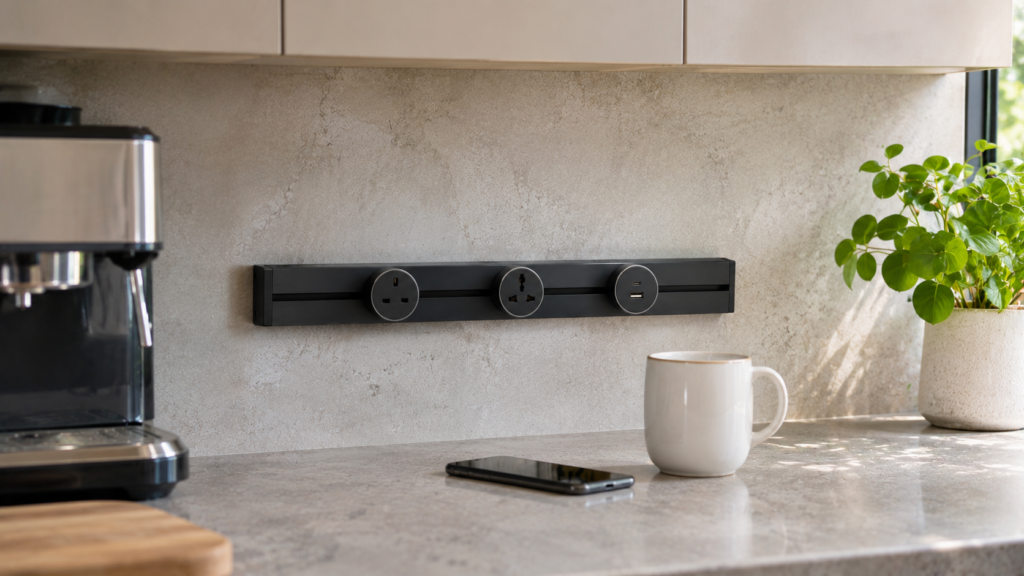
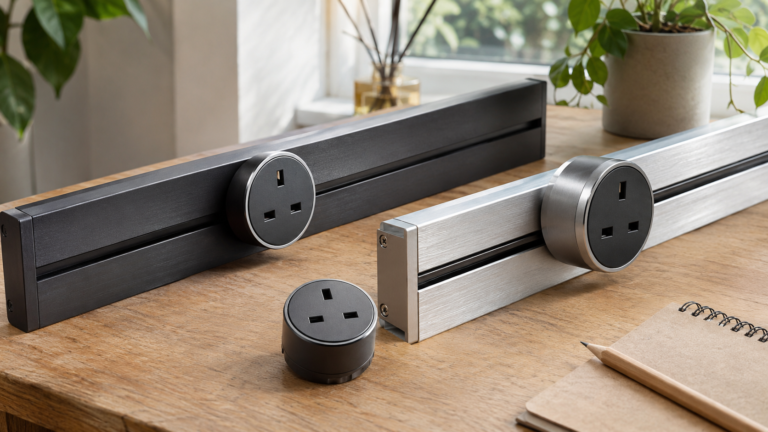
A power track socket adapter is a removable module designed to connect to a compatible electrical rail. Depending on the system, users can choose different outlet types rather than having every socket permanently fixed in one position.
Three common options are:
- UK 13A: for compatible appliances fitted with standard British Type G plugs.
- Universal 3-pin: for selected international plug formats, depending on the socket’s design and specifications.
- USB-C: for charging suitable phones, tablets and other USB-powered devices.
These terms describe the connection available on the front of the adapter. They do not automatically confirm that an adapter will fit a particular power track rail.
For more information about the complete system, read our Power Track Socket Systems UK buying guide.
What Is a UK 13A Power Track Socket Adapter?
A UK 13A power track adapter is designed to provide a British-style three-pin socket connection on a compatible modular rail.
Standard British plugs are commonly called Type G plugs. They have three rectangular pins and are used by a wide range of household appliances.
They are typically found on:
- Electric kettles and toasters.
- Coffee machines.
- Computer monitors.
- Desk lamps.
- Televisions and entertainment equipment.
- Plug-in phone and laptop chargers.
- Many small kitchen appliances.
A suitable UK 13A module can therefore be a practical choice when the main purpose of your power track is to connect ordinary British electrical appliances.
Does 13A mean the adapter can power any kitchen appliance?
No. The 13A designation refers to a current rating, not a guarantee that every appliance or combination of appliances can be used.
The individual adapter, rail, installation and supplying circuit must all be suitable for the intended electrical load.
For example, connecting several high-power kitchen appliances to different modules on one rail does not give each adapter a separate electrical circuit.
The total demand must remain within the limits of the complete installation.
Does a UK 13A power track adapter include a fuse?
In ordinary British domestic arrangements, a standard UK appliance plug typically contains a fuse. This is different from the socket or power track adapter itself.
Do not assume that a power track module contains its own fuse simply because it is described as UK 13A.
If a product claims additional built-in electrical protection, check the actual manufacturer’s specification to understand what is provided.
What Is a Universal 3-Pin Power Track Adapter?
A universal-style power track adapter has a socket face designed to accept more than one plug format, depending on the model.
Manufacturers may offer different arrangements intended for selected European, Asian, American or other international plug types.
However, the word “universal” can be misleading.
It does not necessarily mean that every plug in the world will fit. It also does not establish that the adapter meets the requirements for every country where those plug types are used.
Can you use a UK plug in a universal power track socket?
That depends on the exact adapter.
Some universal-style sockets are designed to accept British Type G plugs, while others support different combinations of plug formats.
The appearance of the socket holes is not sufficient evidence that the product is suitable for a particular plug.
For a UK home using ordinary British appliances, a suitable dedicated UK socket module is generally a more straightforward choice than an unidentified universal-style alternative.
Does a universal socket convert the voltage?
No. A universal-style socket should not be confused with a voltage converter.
Its ability to accept a particular plug shape does not mean that it changes the mains voltage to match the connected appliance.
For example, an appliance intended only for a different mains voltage may not be suitable for direct connection to a UK electricity supply, even if its plug physically fits.
Always check the appliance’s input voltage and frequency requirements rather than relying solely on the plug format.
Is a Universal 3-pin adapter better than a UK 13A adapter?
Not necessarily. A universal-style adapter may be useful in a particular supported application, but it is not automatically a better alternative for everyday UK household appliances.
The correct choice depends on the plug types involved, the manufacturer’s specifications and the suitability of the complete electrical arrangement.
For normal British household use, choosing a verified UK-compatible module avoids the uncertainty that can arise with broadly described universal sockets.
What Is a USB-C Power Track Socket Adapter?
A USB-C power track adapter provides a charging connection for compatible electronic devices without requiring a separate mains plug charger.
Unlike a conventional socket module, which supplies mains electricity to a connected appliance, a USB charging module incorporates electronics to provide a suitable low-voltage output.
Depending on its specification, it may be useful for:
- Smartphones.
- Tablets.
- Wireless headphones.
- Portable speakers.
- Rechargeable accessories.
- Other suitable USB-powered devices.
Some power track modules combine USB-A and USB-C ports, allowing different charging cables to be connected.
Does every USB-C power track adapter support fast charging?
No. USB-C describes the physical connector. It does not automatically tell you how much power the module can provide.
For example, a basic USB-C port might provide a 5V output at a specified current, while another model may support USB Power Delivery with higher power levels.
Both may use an identical-looking USB-C connector.
USB Power Delivery, often abbreviated to USB PD, is a charging protocol that enables compatible devices and chargers to negotiate suitable power requirements.
Before buying a USB-C module, check whether it explicitly supports USB PD and what maximum output it provides.
Can a USB-C power track adapter charge a laptop?
Possibly, but not every module can.
Many laptops require more charging power than a basic USB-C module can supply. Some also require support for specific USB Power Delivery profiles.
A module intended mainly for phone charging may not provide sufficient power for a laptop, even though the connector fits.
To determine suitability, check the laptop’s charging requirements, the module’s maximum output, its supported charging protocols and the cable specification.
If these details are not supplied, do not assume that the USB-C port supports laptop charging.
UK 13A vs Universal vs USB-C: Comparison Table
| Feature | UK 13A | Universal | USB-C |
|---|---|---|---|
| Main purpose | British plug appliances | Specified international plug types | USB device charging |
| Connection | Type G three-pin plug | Model-dependent plug formats | USB-C cable |
| Typical use | Kettles, monitors, lamps and chargers | Specific compatible international devices | Phones, tablets and smaller electronics |
| Mains power outlet | Yes | Yes | No, dedicated low-voltage USB output |
| Laptop charging | With a suitable plug-in charger | Only with a suitable approved connection and charger | Only if power output and protocols are suitable |
| Key buying check | UK socket specification and rating | Supported plug types and suitability | Wattage, voltage and USB PD support |
Remember that every module must also be compatible with the power track rail. A matching outlet type alone is not enough.
USB-C Charging: Why Wattage Matters More Than the Port Shape
One of the most useful things to check when comparing USB-C power track adapters is their stated charging output.
Manufacturers may describe USB output using volts (V), amps (A), watts (W) or a combination of these measurements.
Electrical power in watts is calculated by multiplying voltage by current.
For example, an output labelled 5V / 3A represents a maximum nominal output of 15W at those conditions.
However, this does not mean every USB-C port offers 15W, or that a connected device will always receive the maximum available power.
What if a module is advertised as USB 3.1A?
A label such as “USB 3.1A” may refer to the maximum output current advertised for the charging module. It should not be confused with USB 3.1 data technology or a power rating of 3.1 watts.
To understand the actual charging capability, you need the output voltage as well as the current.
It is also important to establish whether the rating applies to one port or the combined output of multiple ports.
Do two USB ports share their charging power?
Some dual-port modules have a shared total charging capacity.
For example, the maximum output available when using one port may be different from the output available when two devices are connected simultaneously.
This behaviour depends on the charging electronics and manufacturer specifications.
When choosing a combined USB-A and USB-C module, look for both the individual port ratings and the total combined output.
Will a USB-C adapter charge a phone faster than a normal plug charger?
Not necessarily.
A high-quality plug-in USB-C charger connected to a suitable UK 13A socket may support faster charging than a basic built-in USB-C module.
The charging speed depends on the charger or module, the cable, the device and the charging protocol supported by each component.
For a more detailed comparison, read our USB Sockets vs Standard UK Sockets: Which Should You Choose? guide.
Can You Mix UK 13A and USB-C Adapters on One Power Track?
Some power track manufacturers provide compatible UK socket modules and USB charging modules for use on the same rail.
This can be useful in a kitchen or home office because different connections can be positioned where they are needed.
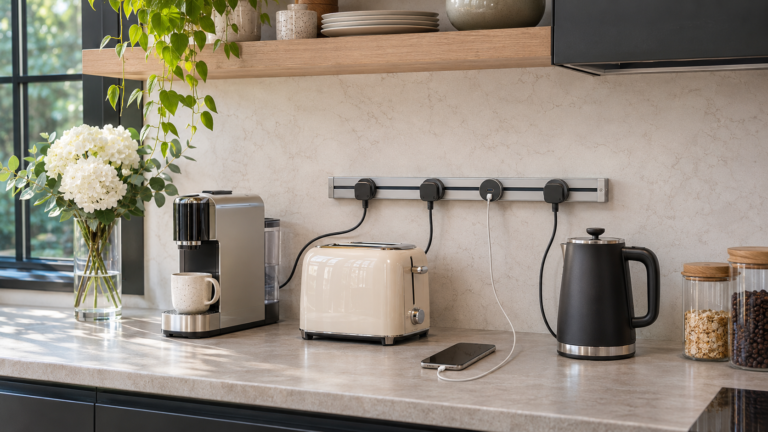
For example, a kitchen arrangement might use a UK three-pin socket for a kettle, another for a coffee machine and a USB-C module for a phone.
However, this arrangement is only appropriate where the manufacturer confirms that all the selected modules are suitable for the same rail.
A UK socket adapter and a USB-C adapter purchased from different sellers should not automatically be treated as interchangeable.
Even modules with similar circular housings may have different electrical contacts or locking mechanisms.
For more information, see our Power Track Socket Adapter Compatibility Guide.
Which Power Track Adapter Is Best for a UK Kitchen?
For most UK kitchens using ordinary British appliances, a suitable UK 13A module is the most relevant option to consider.
Kettles, toasters, coffee machines and many smaller countertop appliances are supplied with British three-pin plugs.
A compatible USB-C module may be useful if phones or other suitable devices are regularly charged near the worktop.
A universal-style module should only be selected for a specific supported need, rather than assuming it is automatically a better replacement for a UK outlet.
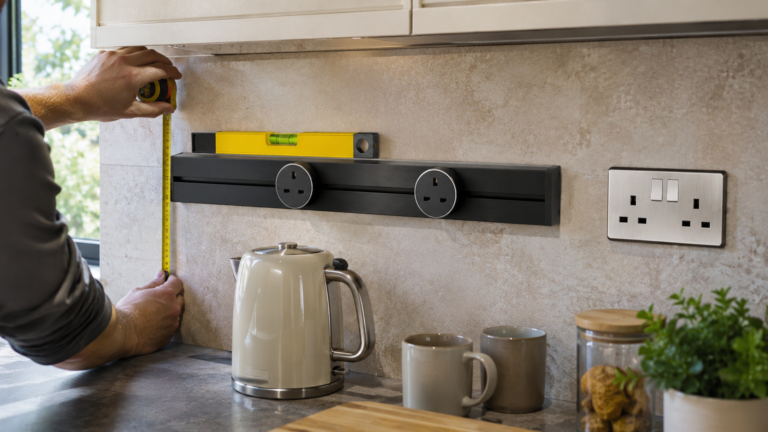
Before buying, also consider the number of appliances, the available rail length and the electrical capacity of the installation.
Several socket modules do not increase the capacity of the supply circuit. If multiple high-power appliances may operate together, have the proposed arrangement assessed by a qualified electrician.
Which Adapter Is Best for a Home Office?
A home office may benefit from a combination of standard UK sockets and USB charging modules.
Computers, monitors, printers and some laptop chargers typically require mains sockets. Phones, headphones and smaller accessories may use USB charging.
The ideal combination depends on your equipment.
If your laptop uses a separate mains charger, a suitable UK 13A adapter may be the simplest choice.
If you prefer direct USB-C laptop charging, check that a compatible module supports the required power output and charging protocol.
Also consider the physical space needed for plugs, bulky chargers and cables. A socket that looks conveniently positioned when empty may be less practical once a large charger is connected.
Should You Buy More UK 13A Modules or Add a USB-C Adapter?
Think about how your devices are connected rather than choosing modules solely by their appearance.
If most of your equipment uses British three-pin plugs, additional compatible UK socket modules may be more useful.
If you frequently charge phones and tablets, a USB-C module could reduce the need for separate chargers.
However, a normal UK socket also gives you the flexibility to use a newer plug-in charger if your charging requirements change.
USB charging technology can change faster than the physical design of a conventional mains socket. A dedicated USB-C module is convenient, but it is worth checking whether its output will continue to meet your likely needs.
How to Avoid Buying the Wrong Power Track Adapter
Before ordering any additional socket modules, work through these checks.
1. Identify your existing power rail
Check the manufacturer, series and model number. Different brands may use incompatible connection systems.
2. Look at your appliance’s connection
Identify whether you need a UK three-pin socket, a specific international plug format or a USB charging port.
3. Check the module’s technical information
For mains socket modules, confirm the appropriate plug format and electrical rating. For USB modules, check output voltage, current, wattage and supported charging protocols.
4. Check the exact product variation
Some online listings offer rails and socket adapters as separate selectable variations. Choosing a UK socket option may mean buying an individual adapter rather than a complete power track system.
5. Confirm rail compatibility
Do not rely on colour, diameter or appearance to establish that a module fits an existing track.
6. Consider future use
If you expect to add more devices later, check whether the manufacturer offers matching modules and whether the existing installation has suitable capacity.
7. Ask before buying if specifications are unclear
If the supplier cannot confirm the required compatibility or charging performance, it is better to clarify those details before placing an order.
Common Mistakes When Choosing Power Track Adapter Types
- Assuming universal means compatible with everything: the supported plug formats and electrical suitability still need to be checked.
- Confusing USB-C with fast charging: USB-C is a connector, not a guarantee of USB Power Delivery.
- Buying only the socket module: the module also needs its compatible power rail.
- Mixing different power track brands: adapters may not share the same connection system.
- Confusing adapter current with total track capacity: each rating applies to a particular component or arrangement.
- Ignoring shared USB output: charging performance may change when multiple devices are connected.
- Choosing by colour alone: visually matching modules may have different specifications.
- Assuming every USB-C module charges laptops: the laptop’s power requirements must be supported.
Our Common Mistakes When Buying Sockets and Switches guide covers other details that are easy to overlook when purchasing electrical accessories.
Frequently Asked Questions
What is the difference between UK 13A and Universal 3-pin power track adapters?
A UK 13A adapter is intended for suitable British three-pin plugs. A universal-style adapter may accept a selection of international plug formats, depending on its design. The two should not automatically be treated as equivalent for UK household use.
Is a universal power track socket compatible with UK plugs?
Some models may accept Type G plugs, but compatibility must be confirmed from the exact specification. Physical fit alone is not enough to establish suitability.
Can a USB-C power track adapter replace a normal plug socket?
Not for ordinary mains-powered appliances. A USB-C module provides low-voltage charging output, while a UK 13A socket provides a connection for suitable mains-powered devices and plug-in chargers.
Can I plug a kettle into a USB-C power track adapter?
No. A conventional electric kettle requires an appropriate mains power connection, not a USB-C charging port. Use a suitable UK socket arrangement and follow the appliance’s instructions.
Can I charge my phone from a UK 13A power track adapter?
Yes, by using a suitable plug-in phone charger. A dedicated USB-C module may allow direct cable charging without the separate charger.
Does every USB-C adapter support USB Power Delivery?
No. USB Power Delivery is an optional charging capability. Check the manufacturer’s information for explicit USB PD support and the maximum available output.
Can I use UK 13A, Universal and USB-C adapters on the same rail?
Only if the manufacturer confirms that those exact modules are compatible with the rail and the complete installation is suitable. Similar appearance does not establish compatibility.
Are UK 13A power track adapters all the same size?
No. Manufacturers may use different outer dimensions, connection mechanisms and housing designs. Matching the UK plug format does not guarantee that an adapter will fit a particular rail.
What does 5V 3A mean on a USB power track adapter?
It identifies an output of 5 volts at up to 3 amps under the stated conditions, equivalent to 15 watts. Check whether that rating applies to one port or to the module’s combined output.
Do I need a separate power track rail for USB-C modules?
A USB-C power track module normally requires a compatible powered rail, just like the mains socket modules in the same system. It should not be confused with an ordinary standalone USB wall charger.
Explore Power Track Socket Options at PYC Online
PYC Online offers modular power track products with different rail lengths, finishes and selectable socket options.
You can explore our Power Track Socket Rail with UK and USB-C options or view the Wall Power Track Socket range.
Available variations include UK 13A, Universal 3-pin and USB Type-C options, depending on the product listing.
Check the selected variation carefully to establish whether you are purchasing a rail or an individual module. The number of included components and their compatibility should be confirmed before ordering.
If you need additional adapters for a rail you already own, contact us with the original product details so we can help clarify the available options with the supplier.
Final Thoughts
UK 13A, Universal 3-pin and USB-C power track adapters may look similar, but they are designed for different types of connections.
For most British household appliances, a suitable UK three-pin module is the natural starting point. USB-C modules are worth considering where convenient device charging is important, provided their output meets the requirements of the devices being charged.
Universal-style sockets require more careful checking because the supported plug formats and electrical specifications vary by model.
Whichever type you choose, the most important details are the same: confirm compatibility with your power track, check the electrical specifications and make sure you understand exactly what is included in the selected product variation.
Related Guides
- Power Track Socket Systems UK: How They Work and What to Know Before Buying
- Do Power Track Socket Adapters Fit Different Brands? Compatibility Explained
- Can You Replace an Existing Wall Socket with a Power Track System?
- USB Sockets vs Standard UK Sockets: Which Should You Choose?
- Common Mistakes When Buying Sockets and Switches
People Also Search For
- UK 13A power track socket adapter
- Universal 3 pin power track socket
- Power track USB-C charging adapter
- UK vs universal power track sockets
- Power track socket adapter types
- USB-C power track laptop charging
- Power track USB-C fast charging
- Power track USB 3.1A meaning
- Can universal sockets accept UK plugs?
- Power track Type G socket adapter
- USB-A vs USB-C power track modules
- Power track USB-C Power Delivery
- Replacement UK power track adapter
- Can I mix power track socket types?
Leave a comment