
Front vs Front and Rear Dash Cam: Is a Rear Camera Worth It?
When choosing a dash cam, one of the biggest questions is whether a front-facing camera is enough or if you should invest in a front and rear dash cam system.
A single front dash cam can capture important evidence of incidents on the road ahead. But what happens if another driver hits your car from behind, follows dangerously close or damages your vehicle while it’s parked?
For many UK drivers, a front and rear dash cam is worth considering because it records both directions and provides a more complete picture of road incidents. However, a good front-facing camera may still be the better choice if you want straightforward recording, simpler installation and a lower purchase cost.
In this guide, we’ll compare front vs front and rear dash cams, explain their advantages and limitations, and help you decide which setup makes sense for your vehicle and driving habits.
If you’re new to car cameras, start with our Dash Cam Buying Guide UK for an overview of recording resolution, night vision, GPS, parking mode and installation options.
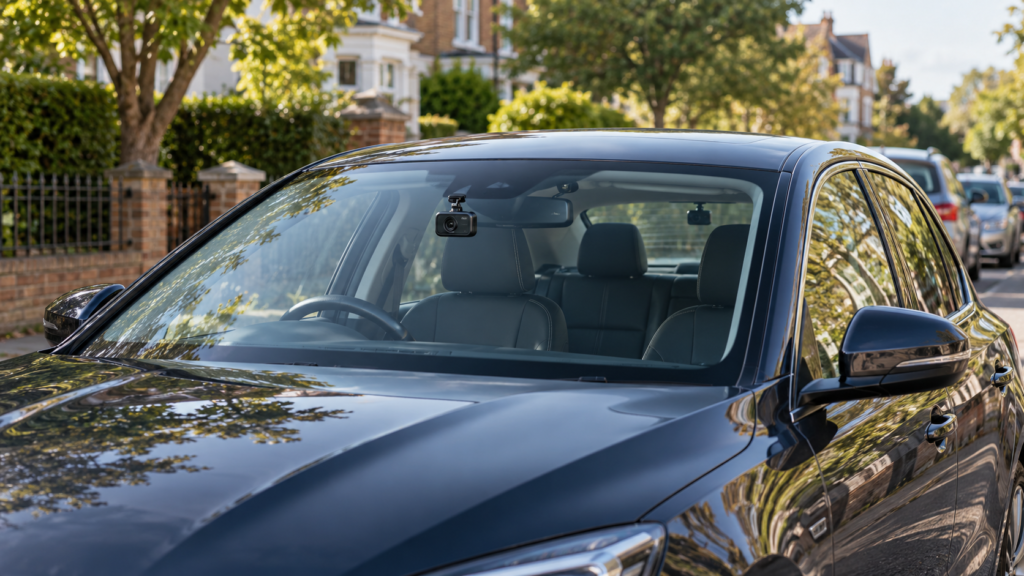
What Is the Difference Between a Front and a Front and Rear Dash Cam?
The main difference is the number of directions recorded.
A front dash cam uses a camera facing through the windscreen to capture the road ahead. This records traffic, junctions, road signs and incidents occurring within its field of view.
A front and rear dash cam usually consists of a main camera mounted at the front of the vehicle and a second camera positioned near the rear window. Both cameras record simultaneously, giving you footage from two directions.
Most dual-camera systems connect the rear camera to the front unit with a cable. The recordings are commonly saved to the same microSD card, although the exact arrangement depends on the model.
| Feature | Front Dash Cam | Front and Rear Dash Cam |
|---|---|---|
| Recording coverage | Road ahead | Road ahead and behind |
| Rear-end collision footage | Limited indirect evidence | Can record the approaching vehicle |
| Installation | Generally simpler | Additional rear camera and cable |
| Purchase cost | Usually lower | Usually higher |
| Memory card usage | Generally lower | Generally higher |
| Parking surveillance | Front coverage if supported | Front and rear coverage if supported |
| Best suited for | Basic everyday recording | Drivers wanting additional coverage |
Neither setup records absolutely everything around a vehicle. Both have blind spots, and even a front and rear system may miss incidents occurring directly alongside the car.
1. Is a Front Dash Cam Enough for Everyday Driving?
For many UK motorists, a front-facing dash cam provides useful protection without the additional cost of a dual-camera system.
It can record incidents such as:
- Another vehicle pulling out unexpectedly at a junction.
- Sudden braking by traffic ahead.
- Dangerous overtaking or lane changes in front of your car.
- Traffic light disputes.
- Road hazards and unexpected obstructions.
- Collisions involving the front of your vehicle.
A front dash cam can also provide indirect evidence of a rear-end collision. For example, the footage may show that your vehicle was stationary or travelling normally before an impact occurred.
However, it will not usually show what the driver behind you was doing immediately before the collision.
Advantages of a Front Dash Cam
- Lower cost: Single-camera models are often more affordable.
- Easier installation: Only one camera needs to be positioned and powered.
- Less wiring: There is normally no rear camera cable to route through the vehicle.
- Lower storage requirements: One recording stream generally consumes less memory than two.
- Simple operation: A suitable camera can record automatically without requiring much interaction.
What Are the Limitations?
The main limitation is that a front-only camera does not record the road behind your vehicle.
If another driver damages your rear bumper, reverses into your parked car or behaves dangerously behind you, the camera may not capture the event directly.
For drivers who mainly want evidence of incidents ahead, this may be an acceptable compromise. For others, rear coverage is worth the additional expense.
2. What Are the Benefits of a Front and Rear Dash Cam?
A front and rear dash cam records two perspectives of your journey, which can provide more context when reviewing an accident or other road incident.
This is particularly useful when an event involves another vehicle approaching from behind.
Recording Rear-End Collisions
Imagine you’re stopped at a set of traffic lights when another vehicle collides with the back of your car.
A front camera may show that you were stationary, but a rear camera could also capture the approaching vehicle and the moments before impact.
This footage may help clarify what happened, particularly where the circumstances are disputed.
However, recording an incident does not automatically establish legal responsibility or guarantee the outcome of an insurance claim.
Capturing Dangerous Driving Behind You
Rear-facing footage may capture tailgating, aggressive driving or unsafe manoeuvres behind your vehicle.
It can provide useful additional information when the front camera alone would show only part of the situation.
Additional Coverage When Parking
With a compatible parking mode, a front and rear system may monitor both directions while your vehicle is parked.
This can be useful if you leave your car on the street, in a supermarket car park or in a shared residential parking area.
Not every dual dash cam supports parking recording, and some require a compatible hardwire kit or external battery.
For a detailed explanation of the available recording modes, see our guide Do Dash Cams Record When the Car Is Off? Parking Mode Explained.
3. Is a Rear Dash Cam Worth It for Motorway Driving?
If you regularly travel on UK motorways or dual carriageways, a rear camera may provide useful additional coverage.
Motorway driving involves higher speeds, frequent lane changes and vehicles approaching from different directions.
A front-facing camera can record traffic ahead and may capture another vehicle moving into your lane.
A rear-facing camera adds another perspective, potentially showing a vehicle approaching closely from behind or changing lanes near the rear of your car.
For example, if another vehicle makes an unsafe manoeuvre immediately behind you, front footage may not show how the situation developed.
Rear footage may help establish the sequence of events.
Our recommendation: If motorway journeys make up a significant part of your driving, a front and rear system is worth considering. The additional viewpoint can be useful when reviewing incidents involving overtaking, lane changes or rear-end impacts.
4. Do Front and Rear Dash Cams Record at the Same Time?
Most dedicated front and rear dash cam systems are designed to record from both cameras simultaneously while powered.
The front unit normally manages recording and saves footage from both cameras to a supported memory card.
Depending on the model, the recordings may be stored as separate front and rear video files.
However, there are several details worth checking before buying:
- Does the camera record both channels simultaneously?
- What resolution does each camera use?
- Does connecting the rear camera reduce the front camera’s available resolution or frame rate?
- Are the front and rear recordings saved separately?
- Can both recordings be viewed through the manufacturer’s smartphone app?
- Does parking mode work with both cameras?
These details vary between products, so a system advertised as 4K does not necessarily record 4K footage from both cameras.
5. Is a 4K Front and Rear Dash Cam Better Than 1080p?
Recording resolution matters, but the overall quality of a dash cam depends on more than the number of pixels.
Front and rear camera systems often use different recording resolutions for each camera.
For example, a system might offer 4K front recording with a 1080p rear camera. Another model might provide 1440p recording at the front and 1080p at the rear.
Neither configuration is automatically better without considering sensor quality, lighting, video processing and compression.
| Configuration | Typical Advantage | Consideration |
|---|---|---|
| 1080p Front Only | Basic recording with lower storage use | No dedicated rear footage |
| 1080p Front + 1080p Rear | Two-direction coverage | Less potential detail than higher resolutions |
| 1440p Front + 1080p Rear | Additional front detail and rear coverage | Higher combined storage requirements |
| 4K Front + 1080p Rear | Higher potential front detail with rear recording | Front and rear image quality may differ |
| 4K Front + 4K Rear | High-resolution recording from both cameras | Usually greater cost and storage demands |
If you’re deciding between a high-resolution front camera and a lower-resolution dual system, think about which matters more to you: additional recording detail or wider coverage.
For further guidance, read our 1080p vs 2K vs 4K Dash Cam comparison.
6. Does a Rear Dash Cam Work at Night?
Yes, a rear dash cam can record at night, but the clarity of the footage depends on the camera and the conditions.
Rear-facing cameras may face additional challenges because they often record through the rear window.
Factors affecting night-time footage include:
- Window tinting: Darkened rear glass can reduce the amount of light reaching the camera.
- Headlight glare: Bright lights from vehicles behind may affect visibility.
- Dirty rear glass: Water, road grime and condensation can reduce image clarity.
- Camera sensor quality: Better low-light performance may improve usable detail.
- WDR or HDR: These technologies may help balance areas of differing brightness.
Some cameras advertise infrared night vision, but this is not automatically the best feature for recording traffic through a rear window. Infrared illumination can reflect from glass, and certain systems are designed mainly for recording the vehicle interior.
If night driving is important to you, check real front and rear footage recorded in low-light conditions rather than relying on resolution claims alone.
7. How Difficult Is It to Install a Front and Rear Dash Cam?
A front-facing dash cam is usually straightforward to fit. The camera is positioned near the rear-view mirror and connected to a suitable power source.
A front and rear system needs an additional cable running from the main unit to the rear camera.
For a neat installation, the cable is commonly routed along vehicle trim and around the interior towards the back window.
Important Installation Considerations
- Position the front camera without obstructing the driver’s view.
- Place the rear camera where it has a suitable view through the back window.
- Check the supplied rear cable is long enough for your vehicle.
- Keep cables away from airbags and their deployment paths.
- Avoid trapping cables in moving tailgates, hinges or trim panels.
- Check the mounting position does not interfere with rear window heating elements or other equipment.
- Ensure the installation is secure and does not interfere with driving.
Hatchbacks, estates and SUVs can present additional cable-routing challenges because the rear window moves with the tailgate.
If you are unsure about safely routing cables around airbags or vehicle trim, professional installation is advisable.
Do You Have to Hardwire a Front and Rear Dash Cam?
No. Many dual-camera systems can record while driving using a compatible vehicle accessory socket or USB power supply.
However, certain parking surveillance features require hardwiring or an external power source.
Our Dash Cam Without Hardwiring guide explains the available power options and what to consider before installation.
8. Are Wireless Front and Rear Dash Cams Available?
The phrase “wireless front and rear dash cam” can create confusion because wireless connectivity does not always mean there are no cables between the cameras.
Many dash cams advertised as wireless actually offer WiFi connectivity for transferring recordings to a smartphone.
Most conventional dual-camera systems still use a cable to connect the rear camera to the main recording unit.
Some specialised systems use other connections or separate recording devices, but these arrangements should not be assumed from the word “wireless” alone.
Before purchasing, check whether the product offers:
- WiFi connection to a smartphone.
- Wireless communication between camera units.
- A physical cable connecting the front and rear cameras.
- A separate power requirement for each unit.
- Cloud access or remote viewing, where supported.
To understand the terminology, read Wireless Dash Cams Explained: WiFi, Power Cables and Installation.
9. Do Front and Rear Dash Cams Need More Memory?
Yes. Recording from two cameras generally produces more video data than recording from a single camera with comparable settings.
This means that a memory card can fill more quickly, and loop recording may overwrite older files sooner.
The amount of storage required depends on:
- Front and rear recording resolutions.
- Video bit rates and compression formats.
- Recording frame rates.
- Whether audio is recorded.
- How often protected event files are saved.
- The capacity of the memory card.
A 128GB or 256GB high-endurance microSD card may be worth considering for certain dual-camera systems, but only if the selected dash cam supports that capacity.
Always follow the manufacturer’s memory card recommendations. Buying a larger card than the camera supports will not necessarily provide additional usable storage.
Learn more in our guide What SD Card Do You Need for a Dash Cam?.
10. Is a Front and Rear Dash Cam Better for Parking Protection?
If your main concern is damage while your vehicle is parked, a front and rear dash cam may provide wider coverage than a single camera.
Imagine your car is parked on a residential street. Another vehicle approaches from behind and collides with your rear bumper while manoeuvring.
A rear-facing camera with an active, suitable parking recording mode may capture the incident.
However, having two cameras does not guarantee that every parking incident will be recorded.
The recording depends on several factors:
- Whether parking mode is supported and enabled.
- Whether the camera has an appropriate power supply.
- Which cameras remain active during parking mode.
- Whether the system uses impact, motion or continuous recording.
- Whether the incident occurs within the camera’s field of view.
- Whether the recording is successfully saved.
Some systems also have a short delay between detecting an event and starting recording, meaning the beginning of an incident might be missed.
If you frequently leave your car parked in public places, parking recording features may be just as important as whether the camera has one or two lenses.
Read our Dash Cam for Parking Protection guide to find out which features matter.
11. Are Front and Rear Dash Cams Legal in the UK?
Yes. Front and rear dash cams are generally legal to use in the UK, provided they are installed and operated safely.
The main considerations include keeping the driver’s view unobstructed and making sure cameras and cables do not interfere with vehicle controls or safety equipment.
As with front-facing recordings, footage captured by a rear camera can raise privacy and data protection considerations depending on how it is used, particularly when shared publicly or recorded for business purposes.
If you travel outside the UK, check the local rules because dash cam restrictions and privacy requirements can differ between countries.
Our Dash Cam Laws in the UK and Europe guide covers important considerations for drivers travelling abroad.
12. Can You Add a Rear Camera to an Existing Dash Cam?
Sometimes, but it depends on the model.
Certain dash cams are designed to support an optional rear camera, while others are permanently limited to front-facing recording.
If you are considering buying a front-only camera now and adding rear coverage later, check the following before purchasing:
- Does the manufacturer support an optional rear camera?
- Which rear camera model is compatible?
- Is the rear camera included or sold separately?
- Will connecting it affect recording resolution or frame rate?
- Is a suitable cable included?
- Does the existing power supply support the full system?
Do not assume that any rear camera will work with any front dash cam. Compatibility between models and manufacturers is often limited.
At PYC Online, some dash cams offer an optional rear camera configuration. When comparing products, check the selected variant carefully so you know whether you are buying a front-only unit or a complete front and rear kit.
You can compare available dash cams and camera configurations at PYC Online.
13. Which Dash Cam Is Best for Your Driving Habits?
Rather than choosing the system with the longest specification list, consider the situations where you would actually benefit from additional recording coverage.
| Driving Situation | Suggested Setup | Reason |
|---|---|---|
| Short daily journeys | Front dash cam | Simple recording of the road ahead |
| Regular motorway commuting | Front and rear dash cam | Additional footage of traffic behind |
| Street parking | Front and rear with compatible parking mode | More coverage while parked |
| Limited budget | Good-quality front dash cam | Prioritises recording reliability and affordability |
| Frequent long-distance driving | Front and rear dash cam | Additional perspectives during road incidents |
| Driving after dark | Camera with strong low-light performance | Night recording quality matters more than camera count alone |
| Wanting basic accident evidence | Front dash cam | Can document many incidents ahead |
Our recommendation: If your budget allows, a well-designed front and rear dash cam can be a sensible long-term choice because it provides additional coverage.
However, a reliable front-facing camera with good image quality is generally a better purchase than a poor-quality dual system selected simply because it includes two cameras.
14. Front vs Front and Rear Dash Cam: Buying Checklist
Before making your final decision, consider these questions:
- Do I mainly want to record the road ahead, or do I need footage from behind?
- How often do I drive on motorways or dual carriageways?
- Do I regularly park on public roads or in busy car parks?
- Does the rear camera record at a suitable resolution?
- How well do both cameras perform at night?
- Is the rear camera included in the package?
- Can I install the system safely in my vehicle?
- Do I need parking mode, and how will the camera be powered?
- What memory card capacity does the system support?
- Can I add a rear camera later if I start with a front-only model?
Answering these questions will help you decide whether the additional coverage is worth the purchase and installation cost.
Frequently Asked Questions
Is a front and rear dash cam worth it?
For many UK drivers, yes. A front and rear dash cam provides recordings from two directions, which can be useful in rear-end collisions, motorway incidents and certain parking situations. However, a front-only camera may be sufficient if you mainly want basic recording of the road ahead.
Is a front dash cam enough for insurance purposes?
A front dash cam can provide useful evidence during insurance claims, especially when an incident occurs ahead of the vehicle. A rear camera may provide additional context if another vehicle approaches or collides from behind. Neither setup guarantees a particular claim outcome.
Can a rear dash cam record a car hitting me from behind?
Yes, if the camera is recording and the incident is within its field of view. A rear-facing dash cam may capture the approaching vehicle and the collision, although visibility depends on lighting, camera position and recording quality.
Are front and rear dash cams difficult to install?
They usually require more installation work than front-only cameras because a cable must be routed to the rear window. Some installations are straightforward, while others are more complex, particularly in vehicles with tailgates and curtain airbags.
Can a front and rear dash cam work without hardwiring?
Yes. Many models can record while driving using a suitable vehicle power socket. However, certain parking monitoring features may require a hardwire kit or separate power source.
Does a rear dash cam record all the time?
Most dedicated dual-camera systems record both cameras simultaneously while powered and configured to do so. Parking recording depends on the model, power source and selected settings.
Do front and rear dash cams use the same memory card?
Many dual-camera systems save both recording streams to a microSD card in the main front camera. However, the arrangement varies between products, so always check the manufacturer’s specifications.
Can I install a rear camera on any dash cam?
No. Some dash cams support compatible add-on rear cameras, while others do not. Rear camera connections and recording systems are not universally interchangeable.
Is a 4K front-only camera better than a 1080p front and rear dash cam?
It depends on your priorities. A good 4K front camera may capture greater detail ahead, while a 1080p dual-camera system records two directions. Camera quality, night-time performance and your recording needs should determine which is more suitable.
Explore More Dash Cam Buying Guides
Choosing between a front and rear camera is only one part of finding the right dash cam. Our Knowledge Hub includes further guides covering the features and practical questions UK drivers should understand before buying.
- Dash Cam Buying Guide UK: How to Choose the Right Dash Cam
- Do Dash Cams Record When the Car Is Off? Parking Mode Explained
- Wireless Dash Cams Explained: WiFi, Power Cables and Installation
- 1080p vs 2K vs 4K Dash Cams: Is 4K Really Worth It?
- Dash Cam Without Hardwiring: How Can You Power It?
- Dash Cam for Parking Protection: What Features Do You Need?
- What SD Card Do You Need for a Dash Cam?
- Are Dash Cams Legal in the UK and Europe? Rules for Driving Abroad
Final Verdict: Front Dash Cam or Front and Rear?
Both options have their advantages, and the right choice depends on how you use your vehicle.
A front dash cam is a practical option for everyday recording. It is generally more affordable, easier to install and capable of capturing many common road incidents.
A front and rear dash cam provides additional coverage, helping document incidents involving vehicles approaching from behind. It may be especially useful for motorway drivers and motorists who regularly park in busy public areas.
Ultimately, reliable recording quality matters more than the number of cameras alone. A well-made dash cam that records clearly and consistently is more useful than a feature-packed system that fails to capture important details.
Ready to choose your dash cam? Browse the PYC Online Dashcam collection to compare front-facing, dual-camera and optional rear-camera configurations.
For more buying advice, visit our Knowledge Hub, where we explain practical technology in clear, straightforward language.
Leave a comment