Power Track Socket Systems UK: How They Work and What to Know Before Buying
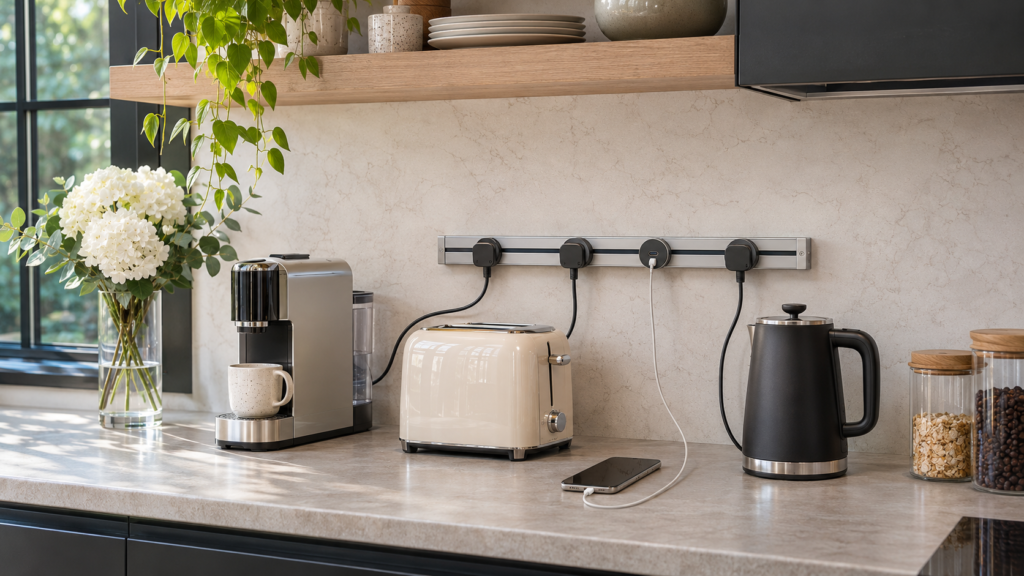
Power track socket systems offer a different approach to powering appliances in kitchens, home offices and other living spaces. Instead of relying entirely on fixed wall sockets, they use a continuous power rail with compatible socket adapters that can be positioned at different points along the track.
For UK homeowners looking to reduce cable clutter or create more flexible access to electricity, a modular socket system can be an interesting alternative to traditional arrangements. However, not every power track works in the same way, and choosing the correct rail and adapters is essential.
This guide explains how power track sockets work, where they are most useful, how they compare with conventional sockets and what to check before buying a system for your home.
What Is a Power Track Socket System?
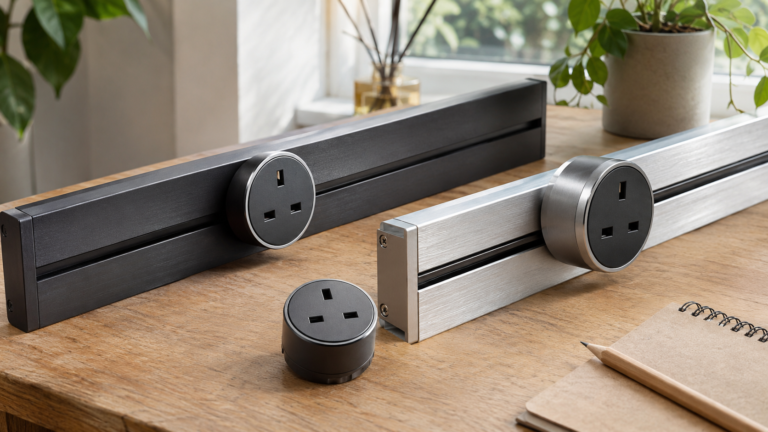
A power track socket system is an electrical distribution system consisting of a specially designed rail and compatible removable socket modules. The rail provides a connection along its length, allowing suitable adapters to be fitted at different positions rather than being permanently fixed to one point on the wall.
Depending on the design, these products may also be described as sliding socket rails, modular power sockets, movable wall sockets or power rail systems.
The main advantage is flexibility. In a traditional kitchen, moving an appliance to another part of the worktop may mean stretching its cable towards the nearest socket. A power track allows the position of a compatible outlet to be changed, provided the rail has been correctly installed and the system is operated according to its instructions.
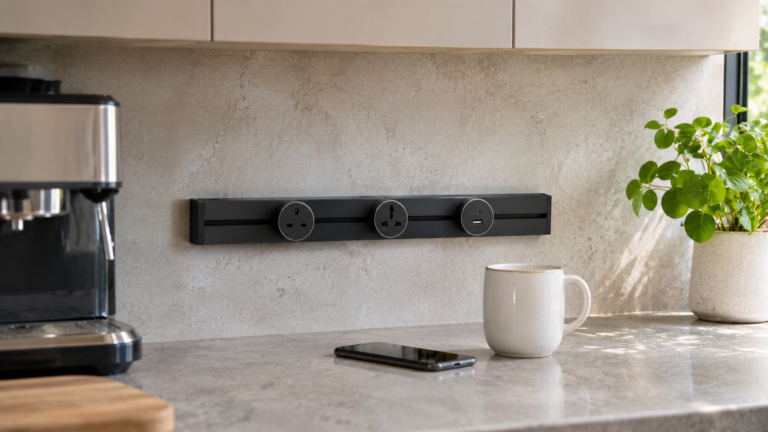
Some systems also offer adapters with USB-A or USB-C ports, allowing compatible devices to be charged without occupying a conventional plug socket.
How Do Power Track Sockets Work?
A power track contains electrical conductors inside a purpose-designed enclosure. Compatible socket adapters connect to these conductors through the connection mechanism specified by the manufacturer.
Many systems use a twist-lock design. An adapter is inserted into the rail and rotated into its operating position. Other systems use different engagement and locking arrangements.
Once correctly connected, the adapter provides an outlet for a suitable appliance or charging device.
The important distinction is that the adapter must be designed for that specific track system. Similar-looking products are not necessarily interchangeable.
Do the sockets actually slide along the rail?
The term “sliding socket” can be misleading. Some products are marketed as sliding systems because the socket position is adjustable, not because the adapter should be physically dragged along the rail while connected.
For example, manufacturer Eubiq instructs users to disengage and remove its adapters before repositioning them. The correct procedure varies by design, so always follow the instructions supplied with the particular model.
Never force an adapter to move or attempt to modify its connection mechanism.
What Parts Make Up a Power Track System?
Understanding the different components is one of the easiest ways to avoid ordering the wrong product.
1. The power track rail
The rail is the main part of the system. It houses the electrical connection arrangement and provides the mounting point for compatible adapters.
Tracks are available in different lengths and finishes. Some are intended for surface mounting, while others are designed to be recessed into furniture or other suitable structures.
2. Socket adapters
Socket adapters provide the connection point for appliances. Depending on the product range, options may include UK three-pin sockets and other regional plug formats.
For most UK households using standard British appliances, a suitable UK 13A socket adapter is the relevant starting point. A universal-style socket should not automatically be treated as an equivalent alternative.
3. USB charging modules
Some systems offer dedicated USB-A or USB-C adapters for charging phones, tablets and other devices.
However, USB-C describes the connector rather than the charging performance. One module may provide basic charging while another supports higher output or USB Power Delivery.
Our existing USB sockets vs standard UK sockets guide explains why charging specifications matter.
4. Installation components
Depending on the system, installation may require mounting hardware, connection accessories, end caps or other manufacturer-specific components.
Do not assume that a product listing includes a complete rail-and-adapter set simply because the photographs show both. Some listings offer individual rail lengths and socket modules as separate selectable options.
Where Are Power Track Socket Systems Most Useful?
Kitchen worktops
Kitchens are a natural place to consider a power track. Kettles, coffee machines, toasters, blenders and other countertop appliances may compete for a limited number of sockets.
A track system can offer more flexibility when arranging smaller portable appliances. It may also provide a cleaner appearance than a row of conventional surface-mounted sockets.
However, the available electrical capacity still matters. Adding more outlets does not automatically increase the amount of power that the supplying circuit can deliver.
Positioning is important too. Electrical Safety First recommends fitting kitchen sockets at a safe distance from sinks, preferably at least 30 cm horizontally where possible. Water exposure, heat and the manufacturer’s installation requirements should all be considered before choosing a location.
Home offices and computer desks
Home offices often have several devices connected simultaneously, including monitors, computers, speakers, desk lamps and chargers.
A power rail can provide accessible connection points across a desk area, particularly where the arrangement of equipment changes regularly.
It is worth checking whether bulky power adapters will obstruct neighbouring modules and whether the rail has enough usable length for the intended setup.
Workshops and hobby spaces
Flexible socket positioning can also be convenient in suitable indoor hobby areas where equipment is moved between workstations.
However, not every domestic power track is designed for workshop conditions. Dust, moisture, mechanical damage and the power requirements of tools may make a different electrical solution more appropriate.
Power Track Sockets vs Traditional Wall Sockets
Both arrangements have advantages. The best choice depends on the room, the appliances being connected and whether flexibility is genuinely needed.
| Feature | Power Track | Traditional Socket |
|---|---|---|
| Outlet position | Adjustable within the compatible rail | Fixed |
| Additional outlets | May accept extra compatible modules | Usually requires another outlet or alternative arrangement |
| Compatibility | System-specific | Standard UK plug interface |
| USB charging | Available on selected modules | Available on selected socket models |
| Best suited to | Spaces needing flexible outlet positions | Everyday fixed electrical connections |
A power track does not have to replace every conventional socket. Many homes may benefit more from a combination of fixed outlets and a carefully selected modular system in one frequently used area.
If you are still planning the number and position of conventional outlets, read our UK room socket planning guide.
Surface-Mounted, Recessed and Plug-In Power Tracks
Power track systems can differ considerably in how they are installed. These distinctions should be checked before ordering.
Surface-mounted tracks
These are designed to sit on a suitable finished surface, such as a wall or approved furniture panel. Their appearance and required clearances depend on the product.
Recessed tracks
Recessed systems are integrated into a prepared opening or suitable structure for a more flush appearance. They require accurate planning of the recess dimensions and the installation method.
Plug-in systems
Some manufacturers offer products designed to connect through a suitable existing socket outlet rather than being permanently wired into the electrical installation.
A wall-mounted hardwired track should not be assumed to support plug-in operation. Likewise, an existing wall socket does not automatically provide a suitable connection point for every track.
Our upcoming guide, Can You Replace an Existing Wall Socket with a Power Track System?, explains the differences in more detail.
For any system requiring a fixed mains connection, have a qualified electrician assess the installation and follow the manufacturer’s instructions.
How to Choose a Power Track Socket System in the UK
Check the correct adapter type
If you plan to use British appliances, look specifically for a suitable UK three-pin adapter. Do not choose an EU, US or universal-style module just because it appears to accept the plug shape.
Check the adapter’s stated specification and whether it is appropriate for the intended device and installation.
Confirm adapter and rail compatibility
Not all power track adapters fit all rails. Even products that look almost identical may have different internal connections or locking mechanisms.
Before buying additional adapters, confirm the manufacturer, product family and compatible rail series. Do not rely on dimensions or photographs alone.
We cover this issue in Do Power Track Socket Adapters Fit Different Brands?.
Choose the right track length
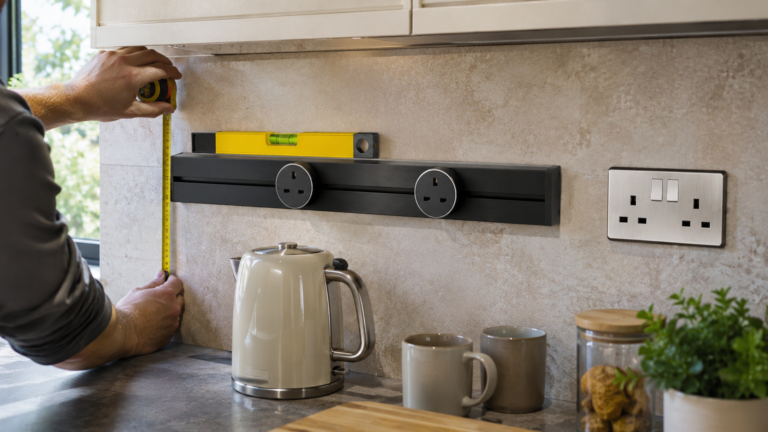
Measure the available space and consider where the adapters will sit when appliances are connected. A rail that fits neatly between two cupboards may still be inconvenient if a large plug or adapter cannot be positioned at the end.
Check the manufacturer’s required clearances, usable track length and permitted mounting orientation.
Understand the electrical limits
Manufacturers may specify separate ratings for the rail, individual adapters and connection arrangement. These figures should not be treated as interchangeable.
For example, a rail advertised with a higher current rating does not mean that every adapter supports that same current. The total usable load also depends on the supply circuit, installation and applicable protective devices.
Do not calculate how many kettles or air fryers can run simultaneously from the advertised rail rating alone. Ask a qualified electrician to assess the proposed load if several high-power appliances will be connected.
Check what is included
Read the selected variation carefully. You may be choosing a rail, an individual socket adapter, a USB charging module or a specific combination.
Before checking out, confirm:
- The selected rail length and finish.
- The number and type of socket adapters included.
- Whether UK 13A or USB-C modules are required.
- Whether additional compatible components are needed.
- The installation method and technical instructions.
This is particularly important when a product page displays several different options in one listing.
Can You Add More Sockets Later?
One of the attractions of a modular power rail is the possibility of adding or repositioning compatible adapters as your requirements change.
However, the number of usable modules is not unlimited. It depends on the track length, the physical spacing required, the manufacturer’s restrictions and the electrical capacity of the installation.
It is also worth considering future availability. If you plan to expand the system later, make sure you can identify its exact model and obtain matching components.
Common Mistakes When Buying Power Track Sockets
The most common buying mistakes are often avoidable with a few checks:
- Ordering a socket adapter without selecting a compatible rail.
- Assuming adapters from different brands will fit.
- Choosing a universal-style socket instead of the required UK version.
- Confusing the rail’s electrical rating with the rating of one adapter.
- Assuming every USB-C module supports laptop charging.
- Buying a rail without checking its installation requirements.
- Assuming sockets can be dragged along the track while connected.
Our guide to common socket and switch buying mistakes covers other details worth checking during a home renovation.
Frequently Asked Questions
Can I use a power track socket in a UK kitchen?
A suitable power track system may be considered for an appropriate kitchen location, provided the product and installation are suitable for the intended use. The position should account for sinks, cooking heat, splashes and the manufacturer’s requirements. A qualified electrician should assess fixed wiring work.
Do power track sockets need a special rail?
Yes. Power track adapters are designed to connect to compatible rails rather than operate as independent plug sockets. Always check the exact system before buying extra modules.
Are all power track socket adapters interchangeable?
No. Similar appearance does not establish compatibility. Different manufacturers and product series may use different connection mechanisms, and an incompatible adapter should never be forced into a rail.
Can I use an existing socket to power a track?
That depends on the system. Some are specifically designed for plug-in use, while others require a fixed electrical connection. The existing supply and the intended track must be assessed before any installation.
Does adding more adapters increase the available power?
No. Additional adapters create more connection points, but they do not increase the capacity of the supply circuit or remove the electrical limits of the track and individual modules.
Can a USB-C power track adapter charge a laptop?
Only if its charging output and supported protocols meet the laptop’s requirements. Some USB-C modules are suitable for phones and smaller devices but do not provide enough power for laptops. Check the wattage and USB Power Delivery specification.
Can a power track rail be cut to size?
Not necessarily. Some manufacturers provide specific cutting instructions for approved systems, while others prohibit cutting their tracks. Never shorten a rail unless its exact manufacturer documentation explicitly permits it.
Can I fit a power track behind a desk or under kitchen cabinets?
Potentially, depending on the model and installation location. Check that there is adequate clearance for adapters and plugs, that the mounting position is permitted and that the electrical connections remain suitable and accessible as required.
Explore Power Track Socket Options at PYC Online
If you are considering a modular socket arrangement for your home or workspace, PYC Online offers power track products with selectable rail lengths and socket module options.
Explore our Power Track Socket Rail with UK and USB-C options or see our Wall Power Track Socket range.
Check the selected product variation and included components before ordering. If you are replacing or expanding an existing system, verify rail and adapter compatibility first.
Final Thoughts
Power track socket systems can be a practical way to create flexible power access without fixing every outlet in one permanent position. They are particularly interesting for kitchen worktops, desks and other suitable spaces where the arrangement of appliances may change.
The right choice depends on more than appearance. Track compatibility, adapter type, power requirements, installation method and the contents of the selected product variation all matter.
Taking the time to check these details can help you choose a system that suits both your room and the equipment you plan to use.
Related Guides
Do Power Track Socket Adapters Fit Different Brands? Compatibility Explained
Can You Replace an Existing Wall Socket with a Power Track System?
UK 13A vs Universal vs USB-C Power Track Adapters: What’s the Difference?
USB Sockets vs Standard UK Sockets: Which Should You Choose?
How Many Sockets Should a Room Have? A Practical UK Guide
Further Reading
Electrical Safety First: Kitchen Electrical Safety
People Also Search For
When researching power track socket systems, buyers often have more specific questions about installation, compatibility and everyday use. Here are some related topics worth exploring:
- Can power track sockets be installed without drilling? Some systems offer alternative mounting methods, but installation options depend on the particular rail and manufacturer’s instructions.
- Can I use power track sockets on a kitchen island? The answer depends on the system, available electrical supply, permitted mounting positions and installation requirements.
- How many sockets can I add to a power track rail? The number depends on the track length, compatible adapter dimensions and the manufacturer’s restrictions.
- Do power track adapters work with different brands? Not necessarily. Read our power track adapter compatibility guide before purchasing additional modules.
- Can I replace an existing double wall socket with a power track? Installation possibilities depend on the track design and electrical supply. Explore our power track installation guide.
- Are USB-C power track adapters suitable for laptop charging? Check the module’s output wattage and supported charging protocols, particularly USB Power Delivery.
- Can I use a kettle, toaster and air fryer on the same power track? The combined load must remain within the limits of the adapters, rail and supplying circuit.
- What happens if I buy a power track adapter that does not fit my rail? An incompatible adapter should not be forced into place or modified. Check the exact track series before ordering a replacement.
- Can I extend a power track rail later? Some systems support manufacturer-approved extensions, while others are supplied as fixed-length units that cannot be joined.
- What is the difference between UK 13A, universal and USB-C power track adapters? These modules serve different purposes. See our power track adapter comparison to understand which type may suit your devices.
Leave a comment