
WiFi vs Zigbee Smart Thermostats: Which Is Better?
Choosing between a WiFi and Zigbee smart thermostat can be confusing, especially when both promise smartphone control, heating schedules and voice assistant integration. They may look almost identical, but the way they connect to your home can make a significant difference.
So, which is better: WiFi or Zigbee?
For a simple smart heating setup, a WiFi thermostat is often the easiest choice because it can connect directly to your home router. Zigbee is worth considering if you want to connect several smart heating devices or already have a compatible Zigbee network.
However, neither technology is automatically better for every home. The right choice depends on your heating system, existing equipment, connectivity requirements and how much control you want.
In this guide, we compare WiFi and Zigbee smart thermostats, explain their advantages and limitations, and help you decide which option makes the most sense for your UK home.
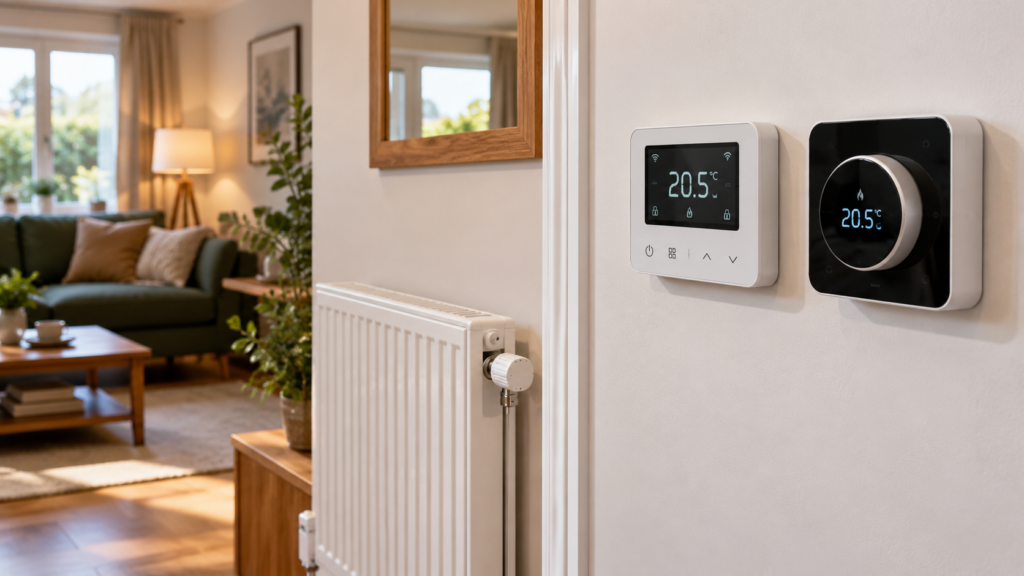
What Is a WiFi Smart Thermostat?
A WiFi smart thermostat connects to your home’s wireless network, usually through a compatible 2.4 GHz WiFi connection. This allows you to manage your heating through a smartphone app, often without purchasing a separate smart home gateway.
Depending on the model, you can adjust the temperature remotely, create heating schedules, change operating modes and connect the thermostat to supported voice assistants.
For example, if you leave work earlier than expected, you may be able to adjust your heating schedule before arriving home.
Many WiFi thermostats work with platforms such as Tuya Smart or Smart Life, while others use manufacturer-specific apps.
Advantages of WiFi Smart Thermostats
- Simple connectivity: Many models connect directly to a compatible home router without a dedicated smart home hub.
- Remote access: Supported apps allow temperature adjustments from outside your home.
- Convenient installation planning: You usually don’t need to plan a separate Zigbee network.
- Voice control: Selected models work with Amazon Alexa or Google Assistant.
- Good for individual devices: A straightforward choice when you only need one or two smart heating controls.
Disadvantages of WiFi Smart Thermostats
WiFi thermostats depend on suitable wireless coverage and compatible network settings. Some devices support only 2.4 GHz WiFi, which can cause confusion when connecting to a router using multiple frequency bands.
They may also rely on internet-based services for remote access and certain smart features.
Power consumption can be another consideration, particularly with battery-powered devices. WiFi is generally more demanding than low-power Zigbee communication, although actual battery life depends on the product and how it operates.
If you plan to connect numerous smart home devices, you should also consider how well your router and wireless network handle additional connections.
What Is a Zigbee Smart Thermostat?
A Zigbee smart thermostat uses the Zigbee wireless communication protocol instead of connecting directly to your WiFi router.
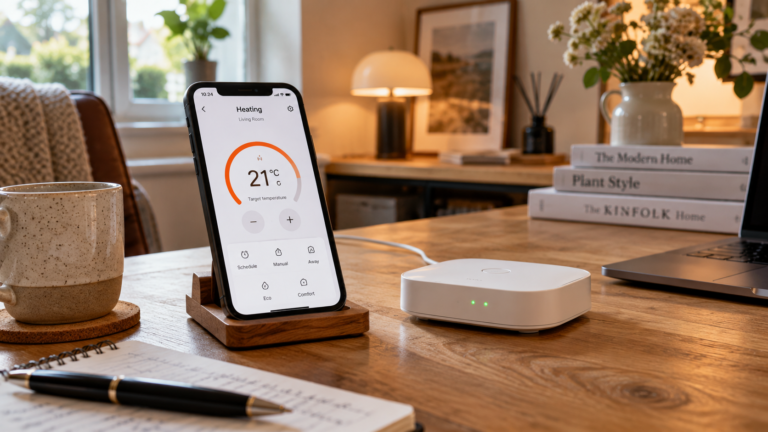
In many home installations, the thermostat communicates with a compatible Zigbee gateway. The gateway connects your Zigbee devices to the wider smart home system and may provide access through an app such as Tuya Smart or Smart Life.
Zigbee is designed for connected devices that exchange relatively small amounts of information, such as temperature readings, commands and device status updates.
This makes it suitable for thermostats, radiator valves, sensors and other smart home equipment.
Advantages of Zigbee Smart Thermostats
- Low-power communication: Useful for compatible battery-operated devices.
- Smart home integration: Multiple supported devices can operate within the same Zigbee network.
- Mesh networking: Compatible mains-powered Zigbee routers can relay signals between devices.
- Less reliance on WiFi connections: Individual Zigbee devices do not each need to connect directly to your router.
- Room-by-room possibilities: Zigbee thermostats and radiator valves can form part of a compatible multi-room heating setup.
Disadvantages of Zigbee Smart Thermostats
The main consideration is the need for a compatible gateway or coordinator.
If you don’t already own one, this may increase the initial cost of your setup. It also adds another piece of equipment that needs to be configured.
Compatibility can be confusing. Two devices may both use Zigbee without supporting the same gateway, app features or automation functions.
Also, although Zigbee supports mesh networking, not every Zigbee device extends the network. Battery-powered thermostats and radiator valves are commonly end devices rather than signal repeaters.
Our guide to Zigbee hubs for smart thermostats and radiator valves explains what you need before buying.
WiFi vs Zigbee Smart Thermostats: Key Differences
The main differences between WiFi and Zigbee thermostats relate to connectivity, power consumption, network structure and the equipment required.
| Feature | WiFi Thermostat | Zigbee Thermostat |
|---|---|---|
| Connection | Connects to a compatible WiFi network | Connects through a Zigbee coordinator or gateway |
| Separate hub | Usually not required | Usually required |
| Power consumption | Generally higher wireless power demand | Designed for low-power communication |
| Network structure | Communicates through WiFi infrastructure | Can use a Zigbee mesh network |
| Smartphone control | Available on supported models | Available through supported gateways and apps |
| Voice assistants | Model dependent | Model and gateway dependent |
| Multiple smart devices | Possible with compatible platforms | Well suited to supported device networks |
| Best suited to | Simple standalone heating setups | Connected smart heating systems |
Both technologies can provide convenient heating control. The important question is which connection method fits the system you want to build.
Which Is More Reliable: WiFi or Zigbee?
Neither WiFi nor Zigbee is guaranteed to provide a more reliable connection in every home.
WiFi performance depends on factors such as router placement, signal strength, network congestion and the construction of your property.
Zigbee performance depends on gateway placement, compatible routing devices, signal interference and the quality of the Zigbee network.
Both technologies commonly operate in the 2.4 GHz radio band, meaning interference can affect either system.
WiFi Reliability
A WiFi thermostat positioned near a reliable router may operate perfectly well without additional equipment.
However, thick walls, long distances and areas with weak wireless coverage can affect connectivity.
If your thermostat is going to be installed in a hallway or another location far from the router, check the strength of your WiFi connection before selecting a model.
Zigbee Reliability
A Zigbee system may benefit from mesh networking, where compatible mains-powered Zigbee devices help relay messages across the network.
This can improve coverage in larger installations, but it requires suitable routing devices placed in appropriate locations.
A single Zigbee thermostat connected to a poorly positioned gateway will not necessarily perform better than a WiFi model.
For either technology, reliable local temperature control and remote app connectivity should be considered separately. Some products continue to operate basic heating functions when internet access is unavailable, while connected features may stop working.
Does Zigbee Work Without the Internet?
Zigbee communication does not inherently require an internet connection. Devices can exchange information locally through a properly configured Zigbee network.
However, this doesn’t mean every Zigbee thermostat offers full offline functionality.
Some gateways, apps and automation services depend on cloud connectivity. Remote access from outside your home will generally require an internet connection.
Likewise, a WiFi thermostat may continue controlling temperature locally even when its cloud connection becomes unavailable.
The important distinction is between local heating control and remote smart features.
Before purchasing, check what the specific thermostat can do without internet access, particularly if maintaining heating schedules and manual control during an outage is important to you.
Which Is Better for Smart Radiator Valves?
If you want to control heating in individual rooms, Zigbee is worth considering because it is widely used in smart thermostatic radiator valves, commonly known as smart TRVs.
These devices adjust compatible radiator valves according to room temperature and programmed settings.
For example, you might want your living room at 20°C during the evening while keeping a spare bedroom at a lower temperature.
A compatible system can help you manage these spaces independently, although coordinating the radiator valves with boiler demand may require an additional controller or supported integration.
Zigbee’s low-power design makes it suitable for battery-operated radiator controls.
At PYC Online, our Zigbee Smart Radiator Valve provides app-based temperature control through the Tuya Smart Life platform and requires a compatible Tuya Zigbee gateway.
To understand the equipment involved, read our Smart Radiator Valves Explained guide.
Which Is Better for a Gas Boiler?
For a gas boiler, choosing between WiFi and Zigbee is less important than confirming that the thermostat supports the correct boiler control method.
Some boilers use simple on/off switching through a suitable relay or dry-contact connection. Others support different control arrangements or communication protocols.
Both WiFi and Zigbee thermostats can be available with boiler-compatible versions, but wireless connectivity alone tells you nothing about electrical or control compatibility.
For example, the Wireless Smart Boiler Thermostat available at PYC Online offers WiFi and Zigbee variants designed for suitable dry-contact boiler systems.
The WiFi version connects through the supported Tuya app, while the Zigbee version requires a compatible Tuya Zigbee gateway.
Before ordering either version, check your boiler’s requirements and the thermostat’s installation documentation.
Our UK smart thermostat and boiler compatibility guide covers the main points to consider.
Which Is Better for Underfloor Heating?
WiFi and Zigbee thermostats can both be suitable for underfloor heating, provided you choose a model designed for the correct system.
Electric underfloor heating often requires a thermostat with the appropriate electrical switching capacity and a compatible floor temperature sensor.
Water-based underfloor heating generally uses controls connected to actuators, manifolds or a wiring centre.
The connection technology does not determine whether the thermostat is compatible with these components.
For example, PYC Online offers a Zigbee Smart Knob Thermostat with different versions for electric heating, water heating and suitable boiler applications.
We also stock a WiFi Smart Thermostat for Underfloor Heating and Boiler Control, with application-specific variants.
These options illustrate why selecting the correct version is essential, regardless of whether you prefer WiFi or Zigbee.
Read our guide to choosing smart thermostats for underfloor heating for further advice.
Is Zigbee More Expensive Than WiFi?
The cost difference depends on the products you’re comparing and what equipment you already own.
A WiFi thermostat may be the more economical starting point if it connects directly to your existing router and doesn’t require additional accessories.
A Zigbee thermostat may need a gateway purchased separately. However, if you already have a suitable Zigbee network, you may not need another gateway.
When comparing prices, look at the complete setup rather than the thermostat alone.
Check whether the advertised package includes the required receiver, gateway, temperature sensor or other accessories. These can vary between product versions.
Also consider future plans. If you’re intending to add multiple smart radiator valves or other compatible devices, a Zigbee network may make more sense than choosing each product independently.
Can WiFi and Zigbee Devices Work Together?
Yes, WiFi and Zigbee devices can work together within a compatible smart home platform.
For example, you might use a WiFi thermostat alongside Zigbee temperature sensors or radiator valves, provided the software, gateway and individual devices support the required integrations.
Some Tuya and Smart Life devices can be managed through the same app even when they use different wireless technologies.
However, being visible in the same app does not guarantee that every device can communicate directly with another or that advanced heating automations will be supported.
Always check the compatibility of the exact products and the functions you want to use.
WiFi vs Zigbee: Which Should You Choose?
The easiest way to decide is to think about your current heating setup and what you want to achieve.
Choose a WiFi Smart Thermostat If:
- You want straightforward smartphone heating control.
- You only need one or two connected thermostats.
- You don’t already use a Zigbee smart home system.
- Your installation location has reliable WiFi coverage.
- You prefer not to purchase a separate gateway where one isn’t required.
Choose a Zigbee Smart Thermostat If:
- You already have a compatible Zigbee gateway.
- You want to build a connected smart heating system.
- You plan to add several supported smart radiator valves or sensors.
- You value low-power communication for suitable battery-operated devices.
- You want to integrate heating with other compatible Zigbee equipment.
If you’re still unsure which type of thermostat suits your heating system, start with our UK Smart Thermostat Buying Guide, which explains compatibility, features and installation considerations.
You can also browse our Smart Thermostat collection to compare available WiFi and Zigbee options.
Frequently Asked Questions
Is Zigbee better than WiFi for smart thermostats?
Zigbee can be a good choice for connected smart heating systems, particularly those using multiple compatible devices. WiFi is often simpler for a standalone thermostat. Neither is universally better.
Do I need a hub for a WiFi smart thermostat?
Many WiFi thermostats connect directly to a compatible home router without a separate smart home hub. However, some systems require a dedicated receiver or additional control equipment for heating operation.
Do all Zigbee thermostats need a gateway?
Zigbee devices generally need a compatible coordinator or gateway to join a Zigbee network. Some existing smart home systems provide this functionality, so a separate gateway purchase may not always be necessary.
Will a Zigbee thermostat work with my WiFi router?
A Zigbee thermostat normally does not connect directly to a standard WiFi router. It communicates through a Zigbee network, typically using a compatible gateway connected to your home network.
Can I use Zigbee and WiFi smart thermostats in the same house?
Yes. Both types can operate in the same property. Whether they can share controls, schedules or automations depends on the supported apps and smart home integrations.
Which technology is better for battery-powered thermostats?
Zigbee is designed for low-power communication and can be advantageous for battery-operated devices. However, actual battery life depends on the thermostat’s hardware, software and usage rather than the wireless protocol alone.
Do WiFi and Zigbee thermostats save the same amount of energy?
The wireless technology itself does not determine heating savings. Energy use depends on your heating system, schedules, temperature settings and household habits. Read our guide to smart thermostat energy savings for more information.
Final Thoughts
When comparing WiFi vs Zigbee smart thermostats, the best option is the one that fits your home heating system and how you intend to use it.
WiFi is often a convenient choice for simple remote heating control without building a separate smart home network. Zigbee offers advantages for households planning multiple connected devices, particularly smart radiator valves and compatible sensors.
Neither technology makes a thermostat automatically more accurate, more efficient or compatible with your boiler.
Before buying, check the heating system requirements, supported app, gateway needs and exact product variant. Getting those details right matters far more than choosing a technology based on its name alone.
Related Guides
- How to Choose a Smart Thermostat for Your Home: UK Buying Guide
- Will a Smart Thermostat Work With My Boiler?
- Smart Thermostat vs Smart Radiator Valves
- Smart Radiator Valves Explained
- Best Smart Thermostats for Underfloor Heating
- Do You Need a Zigbee Hub for a Smart Thermostat?
- Do Smart Thermostats Save Money on Heating Bills?
Further Reading
- Connectivity Standards Alliance – Information about Zigbee and connected device standards.
- Energy Saving Trust – Independent guidance on heating controls and home energy efficiency.
- Electrical Safety First – UK electrical safety guidance.
People Also Search For
wifi vs zigbee smart thermostat, zigbee vs wifi heating controls, best smart thermostat UK, wifi smart thermostat, zigbee smart thermostat, do zigbee thermostats need a hub, zigbee thermostat without internet, wifi thermostat for gas boiler, tuya wifi thermostat, tuya zigbee thermostat, smart radiator valve zigbee, smart thermostat compatibility, wifi or zigbee smart home, smart heating system UK


Leave a comment