
Will a Smart Thermostat Work With My Boiler? UK Compatibility Guide
Thinking about upgrading to a smart thermostat but unsure whether it will work with your boiler? You’re not alone. Boiler compatibility is one of the most important things to check before buying a smart heating controller, particularly if you’re replacing an older thermostat.
Most UK homes with a compatible gas central heating system can use a smart thermostat, but not every smart thermostat works with every boiler. Compatibility depends on the boiler’s control connections, the type of heating system, the thermostat’s electrical requirements and whether additional equipment is needed.
The good news is that you don’t necessarily need a new boiler to enjoy smart heating controls. Many existing heating systems can be upgraded with a suitable thermostat.
This guide explains how to check whether a smart thermostat will work with your boiler, the differences between common UK heating systems and what to look for before making a purchase.
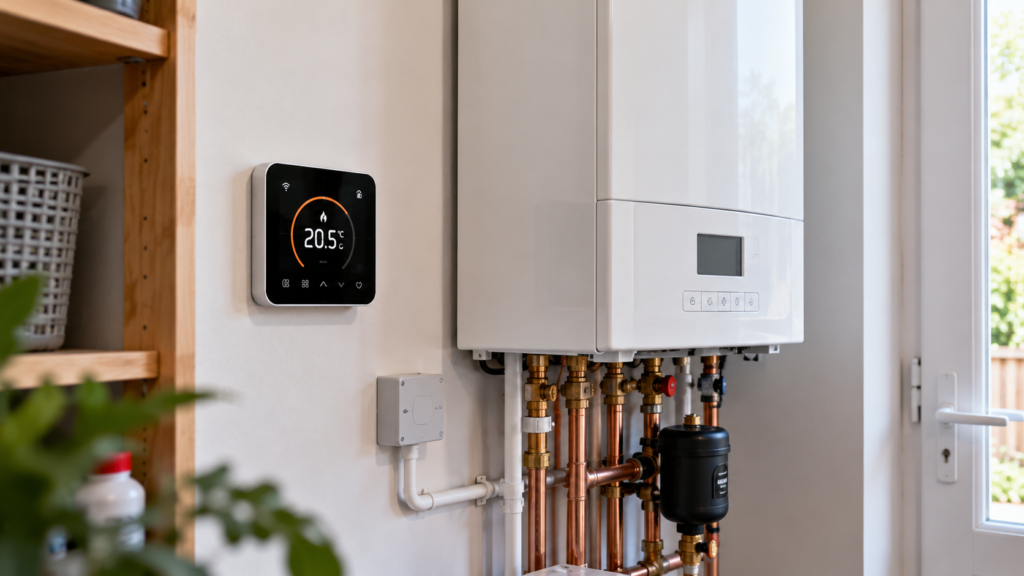
Can You Use a Smart Thermostat With an Existing Boiler?
Yes, many existing boilers can be connected to a suitable smart thermostat. You don’t always need to replace your heating system or install an entirely new controller.
However, the word “smart” describes the thermostat’s features rather than its compatibility with your boiler.
A thermostat might support WiFi, smartphone control, Alexa and heating schedules while still being unsuitable for your particular boiler installation.
Before choosing a model, you need to understand how your existing heating controls communicate with the boiler.
Some installations use a simple on/off signal. Others support more advanced communication between the boiler and thermostat. Certain systems also require receivers, motorised valves or separate hot water controls.
If you’re starting from scratch, our UK Smart Thermostat Buying Guide explains the main types of heating controls and features worth considering.
1. Identify Which Type of Boiler You Have
In the UK, the three main types of domestic gas boiler installation are combi, system and regular boilers. Understanding which one you have is a useful first step when checking thermostat compatibility.
Combi Boilers
A combination boiler, usually called a combi boiler, provides central heating and hot water without requiring a separate domestic hot water storage cylinder.
Many combi boiler installations can use a smart room thermostat to control central heating demand.
Depending on the boiler, this may involve an on/off relay connection or a compatible digital control interface.
However, not every combi boiler accepts the same thermostat connections. Some require manufacturer-specific controls, while others offer different connection options.
It’s also important to understand that controlling central heating doesn’t necessarily mean controlling domestic hot water functions through the same thermostat.
System Boilers
A system boiler usually works with a separate hot water cylinder. Heating and stored hot water may be controlled through a programmer, room thermostat, cylinder thermostat and other components.
Upgrading to smart controls can be possible, but you need to consider the complete heating arrangement rather than only the boiler itself.
For example, a smart room thermostat may manage central heating while separate equipment continues controlling hot water.
Some smart heating systems offer both functions, but this depends on the controller and installation.
Regular Boilers
Regular boilers, sometimes called conventional or heat-only boilers, are often found in older UK properties.
These systems commonly include a separate hot water cylinder and may also use feed and expansion tanks.
Depending on the installation, heating controls can include a programmer, room thermostat, cylinder thermostat, motorised valves and wiring centre.
A smart thermostat may still be suitable, but replacing an existing wall control without checking the wider system can cause problems.
If your home has a regular boiler, a heating professional should assess how a replacement controller will interact with the existing programmer and hot water controls.
2. Understand On/Off, Dry Contact and OpenTherm Controls
One of the most important compatibility checks is understanding how a thermostat communicates with the boiler.
Two common approaches are on/off control and modulating control.
On/Off Thermostat Control
A conventional on/off thermostat tells the heating system whether there is a demand for heat.
When the room temperature falls below the selected setting, the thermostat requests heating. Once the target temperature is reached, it stops requesting heat.
This is a widely used method of controlling central heating.
Some smart thermostats provide on/off control through a suitable relay output. However, the relay and its electrical characteristics must match the boiler or heating controls.
What Is a Dry Contact Thermostat?
A dry contact, sometimes called a volt-free contact, is an electrical switching contact that does not supply its own voltage to the controlled circuit.
Instead, it opens or closes a connection that can be used by compatible boiler controls.
Some boilers are designed to accept this type of switching input, making a suitable dry-contact thermostat an option for certain installations.
However, dry contact does not automatically mean universal boiler compatibility.
It’s essential to confirm whether the boiler requires a volt-free connection, a voltage-switched input or another control arrangement.
Connecting the wrong type of output can damage equipment or create an unsafe installation.
What Is OpenTherm?
OpenTherm is a digital communication protocol used by certain boilers and compatible heating controllers.
Unlike basic on/off switching, a compatible modulating system can communicate heating demand information and adjust boiler operation more gradually.
For example, instead of simply requesting full heating operation, a suitable controller may ask the boiler to adjust its output to match the home’s heating demand.
This can help the heating system operate more efficiently in appropriate conditions.
However, not every boiler supports OpenTherm, and not every smart thermostat provides OpenTherm communication.
A thermostat advertised as WiFi, Zigbee or Tuya-compatible should not be assumed to support OpenTherm.
Some boilers use manufacturer-specific communication systems rather than an openly supported protocol.
If retaining your boiler’s modulating control is important, confirm the exact communication requirements with the boiler manufacturer or installer before choosing a replacement.
3. Check Your Boiler Model Before Buying
Knowing that you have a combi boiler is helpful, but the exact make and model will give you more useful compatibility information.
Two boilers from the same manufacturer may support different controls, particularly if they were produced several years apart.
Start by finding the boiler’s model name and number. This is usually printed on the appliance or provided in its documentation.
Once you have the model details, check the manufacturer’s installation manual or ask a qualified heating professional to confirm the supported thermostat connections.
What Information Should You Look For?
- Boiler make and model: Identify the exact appliance, not just the manufacturer.
- Existing heating controls: Check whether you currently use a wall thermostat, programmer, wireless receiver or integrated boiler controller.
- Control interface: Establish whether the boiler supports on/off switching, volt-free contacts, OpenTherm or manufacturer-specific communication.
- Hot water controls: Check whether your installation includes a separate hot water cylinder and controller.
- Power requirements: Determine whether the new thermostat needs batteries, a mains connection or a separate receiver.
- Additional equipment: Confirm whether a gateway, receiver or compatible control module is required.
This information is much more useful than choosing a thermostat solely because its product description mentions gas boilers.
4. Will a WiFi or Zigbee Thermostat Work With My Boiler?
Both WiFi and Zigbee smart thermostats can be suitable for certain boiler installations, but the wireless technology doesn’t determine boiler compatibility.
WiFi and Zigbee describe how a device connects to a network or smart home platform. The thermostat still needs the appropriate electrical output and control method for your heating system.
WiFi Boiler Thermostats
Many WiFi thermostats connect to a compatible home router and offer heating control through a smartphone app.
This can be a convenient choice if you want basic remote control and programmable schedules without building a larger smart home network.
Some WiFi boiler thermostats include a receiver or use a suitable relay output for compatible heating controls.
Zigbee Boiler Thermostats
Zigbee thermostats usually communicate through a compatible Zigbee gateway, which can connect them to an app and other supported smart home devices.
This may be useful if you’re planning to introduce smart radiator valves or other connected equipment.
However, choosing Zigbee does not automatically provide more advanced boiler control or better heating efficiency.
Read our WiFi vs Zigbee Smart Thermostats comparison for a more detailed explanation of the differences.
5. Do You Need a Wireless Receiver or Gateway?
Another important consideration is whether your chosen thermostat needs additional equipment.
These components have different purposes and shouldn’t be confused.
Wireless Receiver
In some heating systems, a wireless room thermostat communicates with a separate receiver connected to the boiler or central heating controls.
The thermostat measures room temperature and sends instructions to the receiver, which provides the appropriate heating control signal.
A wireless thermostat is not necessarily capable of controlling the boiler on its own.
Before buying, check whether a compatible receiver is included or must be purchased separately.
Smart Home Gateway
A Zigbee gateway allows compatible Zigbee devices to communicate with a smart home platform.
It does not automatically replace a boiler receiver or provide the correct electrical connection to every heating system.
For example, a Zigbee radiator valve may communicate successfully with its gateway without being able to request heat directly from the boiler.
If you’re considering Zigbee heating controls, read Do You Need a Zigbee Hub for a Smart Thermostat? before choosing your equipment.
6. Can You Replace an Old Thermostat With a Smart Thermostat?
In many cases, an older room thermostat can be replaced as part of a smart heating upgrade.
However, it isn’t always a direct replacement.
An existing wall thermostat might use mains-voltage wiring, low-voltage controls or a wireless connection to a separate receiver.
A replacement thermostat could require a neutral conductor that isn’t present at the existing location, or it might use a different type of switching output.
Some models are battery-powered, while others need a permanent electrical supply.
Even if a new thermostat fits in the same location, this doesn’t guarantee electrical compatibility.
For UK homes, fixed electrical wiring and boiler-control connections should be assessed by an appropriately competent professional. Where work involves gas appliances or their safety-critical components, a Gas Safe registered engineer is required.
Never connect a thermostat based only on matching wire colours or similarities between terminal labels.
7. What About Smart Radiator Valves?
You may be considering a smart thermostat because you want more control over individual rooms rather than simply managing the whole house.
In this situation, smart thermostatic radiator valves, or smart TRVs, may be worth exploring.
These devices adjust compatible radiator valves based on programmed settings or measured temperature.
For example, you might want your living room warmer in the evening while keeping a spare bedroom at a lower temperature.
However, smart radiator valves and central boiler thermostats perform different functions.
A smart TRV can regulate an individual radiator, but this doesn’t necessarily mean it can start or stop the boiler when a particular room requests heat.
Coordinated room-by-room heating may require a compatible boiler controller or supported heating automation.
Our Smart Thermostat vs Smart Radiator Valves guide explains these differences, while Smart Radiator Valves Explained covers the practical requirements for individual room control.
8. Smart Boiler Thermostats Available at PYC Online
At PYC Online, we offer smart heating controls designed for different types of installations, including selected boiler applications.
It’s important to choose the correct version for your existing system and confirm compatibility before purchasing.
Wireless Smart Boiler Thermostat: WiFi and Zigbee Options
Our Wireless Smart Boiler Thermostat is available in WiFi and Zigbee variants intended for compatible dry-contact boiler systems.
The thermostat is battery-powered and supports features such as app-based temperature adjustment and programmable heating schedules.
The WiFi version connects through the supported Tuya platform, while the Zigbee version requires a compatible Tuya Zigbee gateway.
Before ordering, confirm that your heating installation supports the specified control method and check any additional receiver or wiring requirements.
Zigbee Smart Knob Thermostat
Another option is our Zigbee Smart Knob Thermostat, which comes in different application-specific versions.
These include variants intended for suitable gas boiler installations, water heating systems and electric underfloor heating.
Although the devices share a similar appearance, the versions have different control requirements.
Always select the correct application variant and check its technical specification before purchase.
WiFi Thermostat With Boiler-Specific Version
Our WiFi Smart Room Thermostat offers versions for different heating applications, including a WPB variant intended for suitable boiler and dry-contact heating systems.
Other variants are designed for electric or water-based underfloor heating and shouldn’t be treated as interchangeable.
You can explore more options in the PYC Online Smart Thermostat collection.
9. Common Mistakes When Choosing a Boiler Thermostat
Several common mistakes can lead to buying the wrong thermostat or discovering unexpected installation requirements.
- Assuming all gas boilers use the same connections: Different boilers can require different control methods.
- Confusing WiFi or Zigbee with boiler compatibility: Wireless connectivity doesn’t confirm electrical suitability.
- Buying the wrong thermostat variant: Products for electric underfloor heating may not be suitable for boiler control.
- Ignoring existing hot water controls: System and regular boiler installations may have additional requirements.
- Assuming a gateway replaces a receiver: These devices serve different purposes.
- Overlooking power requirements: Some thermostats require mains power, while others use batteries.
- Assuming smart radiator valves control the boiler: Additional compatible equipment may be required.
Checking these points before ordering can help prevent unsuitable purchases and installation delays.
Smart Thermostat Boiler Compatibility Checklist
Before buying a smart thermostat for your boiler, make sure you can answer the following questions:
- Do I have a combi, system or regular boiler?
- What is the exact boiler make and model?
- What type of heating controller is currently installed?
- Does my boiler require on/off switching, a dry-contact relay or another communication method?
- Does it support OpenTherm or manufacturer-specific modulation?
- Will the new thermostat also need to control stored hot water?
- Does the thermostat require mains power, batteries or a separate receiver?
- Do I need a compatible WiFi network or Zigbee gateway?
- Have I selected the correct thermostat version for my heating system?
- Has a suitably qualified installer confirmed the proposed connection?
If you’re unsure about any of these points, check the manufacturer’s installation documentation or speak to a qualified heating professional before placing your order.
Frequently Asked Questions
Do smart thermostats work with all combi boilers?
No. Many combi boilers support suitable smart heating controls, but compatibility depends on the exact model and its supported control connections. Some use on/off switching, while others support digital or manufacturer-specific communication.
Can I use a smart thermostat with an old boiler?
Possibly. Many older heating systems can be upgraded, but the existing wiring and control arrangement need to be checked. Boiler age alone doesn’t determine compatibility.
Do I need an OpenTherm thermostat for my boiler?
Not necessarily. OpenTherm is relevant if your boiler supports it and you want to use compatible modulating controls. Some boilers use on/off switching or different proprietary communication methods.
Does a WiFi thermostat need to be connected directly to the boiler?
It depends on the model. Some thermostats are wired directly into suitable heating controls, while others communicate with a separate receiver connected to the boiler or heating system.
Can a Zigbee thermostat control a gas boiler?
Yes, certain Zigbee thermostats are designed for compatible gas boiler control systems. However, Zigbee connectivity alone doesn’t establish compatibility. You must check the thermostat’s output and any receiver requirements.
Can a smart thermostat control heating and hot water?
Some smart heating systems can manage both central heating and stored hot water, but not all models offer this feature. Installations with separate hot water cylinders may require additional controls.
Can I install a smart boiler thermostat myself?
Some battery-operated devices are straightforward to set up, but connecting a thermostat to fixed electrical wiring or boiler controls requires suitable competence. For boiler-control changes, professional assessment is recommended, and gas-related work must be completed by an appropriately registered engineer where required.
Will changing my boiler thermostat reduce heating bills?
A compatible smart thermostat can help manage heating schedules and reduce unnecessary heating, but savings are not guaranteed. Results depend on your existing controls, home insulation and how you use the heating system. Read our guide to smart thermostat energy savings for more information.
Final Thoughts
A smart thermostat can be a useful upgrade for many UK heating systems, but boiler compatibility should always come before additional features.
Start by identifying your boiler type and exact model. Then check how the existing heating controls operate and whether your chosen thermostat supports the correct connection method.
Remember that WiFi, Zigbee, dry contact and OpenTherm describe different aspects of a heating system. Understanding these differences will help you avoid choosing an unsuitable product.
Once compatibility has been confirmed, you can focus on the features that matter most to you, whether that’s smartphone control, heating schedules, voice assistants or room-by-room temperature management.
Explore our range of smart thermostats and heating controls to compare available options for your home.
Related Guides
- How to Choose a Smart Thermostat for Your Home: UK Buying Guide
- WiFi vs Zigbee Smart Thermostats: Which Is Better?
- Smart Thermostat vs Smart Radiator Valves: What’s the Difference?
- Smart Radiator Valves Explained: How They Work and What You Need
- Best Smart Thermostats for Underfloor Heating: What to Look For
- Do You Need a Zigbee Hub for a Smart Thermostat?
- Do Smart Thermostats Save Money on Heating Bills?
Further Reading
- Energy Saving Trust: Heating Controls – Independent UK guidance on thermostats, heating systems and energy efficiency.
- Gas Safe Register – Information on gas safety and finding registered engineers.
- OpenTherm Association – Information about digital communication standards for heating controls.
- Electrical Safety First – Electrical safety information for UK homes.
People Also Search For
smart thermostat boiler compatibility, will a smart thermostat work with my boiler, smart thermostat for combi boiler, smart thermostat for old boiler, smart thermostat UK, gas boiler smart thermostat, dry contact thermostat, volt free boiler thermostat, OpenTherm vs on off thermostat, WiFi boiler thermostat, Zigbee boiler thermostat, Tuya boiler thermostat, wireless thermostat for gas boiler, smart thermostat installation UK, combi boiler thermostat replacement, smart heating controls


Leave a comment