
How to Check If Your Home Has a Neutral Wire in the UK
How to Check If Your Home Has a Neutral Wire in the UK
The safest way to check whether your UK home has a neutral wire at the light switch is to ask a qualified electrician to inspect the wiring. In a modern installation, neutral wires are normally blue and may be grouped together in a separate connector behind the switch. However, wire colours can vary, particularly in older or modified installations, so colour alone is not enough to identify them safely.
Knowing whether a neutral wire is available is especially important when choosing a smart light switch. Some smart switches require a neutral connection, while others are designed specifically for homes without one.
If you are still deciding which type of switch you need, read our guide: Do I Need a Neutral Wire for a Smart Switch in the UK?
What Does a Neutral Wire Do?
A neutral wire forms part of an electrical circuit. It provides a return path for the electrical current and helps complete the circuit back to the electrical supply.
A traditional mechanical light switch usually controls the live conductor by opening or closing the circuit. It does not normally need its own continuous power supply.
A smart switch is different. Its internal electronics may need to remain powered so the switch can:
- Stay connected to Wi-Fi or a smart home hub.
- Receive commands from an app.
- Respond to voice controls.
- Run timers, schedules and automations.
- Show its current connection or operating status.
For this reason, many smart switches require both a permanent live connection and a neutral connection.
What Colour Is a Neutral Wire in the UK?
In most modern UK fixed electrical installations, the standard conductor colours are:
- Live: brown
- Neutral: blue
- Earth: green and yellow
Older UK installations may use different colours, including red for live and black for neutral.
| Conductor | Modern UK Colour | Older UK Colour |
|---|---|---|
| Live | Brown | Red |
| Neutral | Blue | Black |
| Earth | Green and yellow | Green or unsleeved conductor in some older installations |
Do not assume that a wire is neutral simply because it is blue or black. A conductor may have been repurposed, incorrectly marked or installed as part of an older or modified circuit. Proper testing is needed to confirm its function.
Do All UK Homes Have a Neutral Wire?
UK homes generally have neutral conductors within their electrical installations, but this does not mean that a neutral wire will be present behind every light switch.
In many traditional lighting circuits, the neutral connection is located at the ceiling rose or light fitting. Only the permanent live and switched live conductors run between the light fitting and the wall switch.
This arrangement is particularly common in older properties, but the age of the home does not provide a definite answer. A newer property may have been wired in different ways, while an older property may have been rewired or extended.
You should therefore check each switch location individually rather than assuming that every room has the same wiring arrangement.
How Can I Tell If There Is a Neutral Wire Behind My Light Switch?
There are several clues that may suggest a neutral connection is present, but none should replace proper electrical testing.
1. Check the Installation Information
Before inspecting the switch, look for any electrical installation certificates, rewiring records or information left by the electrician who completed the work.
These documents may not show the exact conductors behind each switch, but they can provide useful information about when the installation was completed or last modified.
2. Consider the Type of Existing Switch
If you already have an electronic timer, illuminated switch or another device that requires permanent power, there may be a neutral connection behind it.
However, some electronic controls are designed to work without a neutral, so the type of switch alone cannot confirm the wiring arrangement.
3. Look at the Wiring Only After Safe Isolation
The switch faceplate must not be removed while the circuit is live. Turning the light off at the wall switch is not enough because electrical conductors may still be live behind it.
The relevant circuit must be correctly isolated at the consumer unit and confirmed as dead using suitable test equipment. If you do not know how to complete safe isolation, do not remove the switch plate.
4. Look for a Separate Group of Conductors
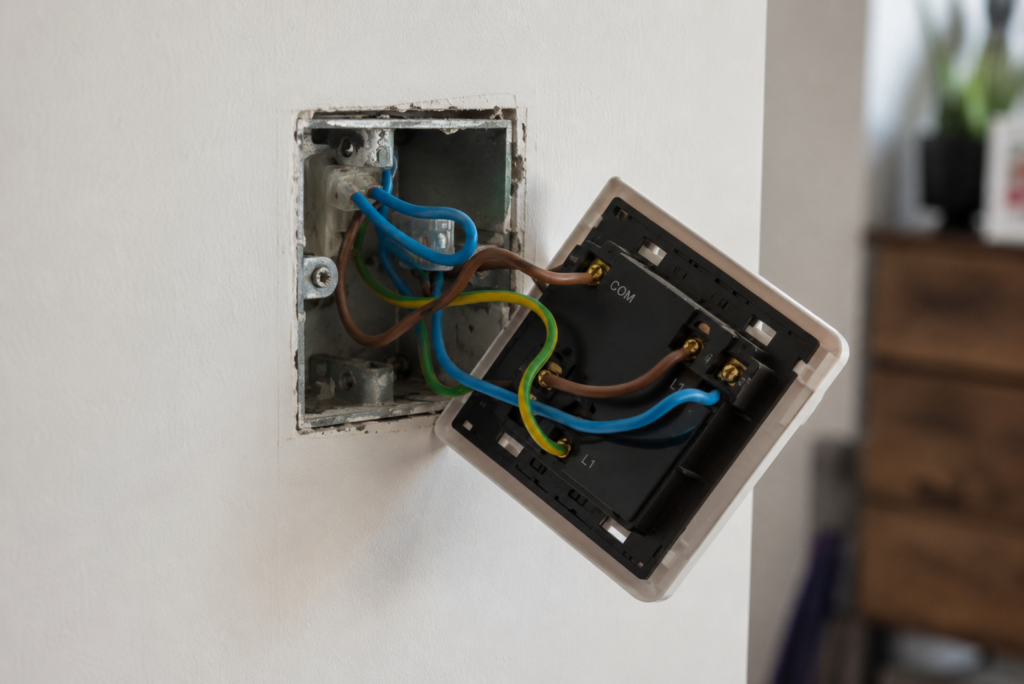
Where a neutral is present, it may appear as two or more blue conductors joined together in a separate insulated connector at the back of the wall box.
The neutral conductors are not always connected directly to a traditional mechanical switch. They may be positioned behind it because they continue through the circuit to another fitting.
5. Have the Conductors Tested
The only reliable way to identify a neutral conductor is through appropriate inspection and electrical testing by someone who understands the circuit.
If the wiring is unclear, crowded, damaged or uses older colours, stop and ask a qualified electrician to check it.
What Might the Wiring Behind a UK Light Switch Look Like?
The wiring arrangement varies depending on the type of circuit and the number of switches controlling the light.
You might find:
- A permanent live and a switched live only.
- Live, neutral and earth conductors.
- Several neutral conductors grouped in a separate connector.
- Additional conductors for a two-way or intermediate lighting circuit.
- Older wiring colours mixed with modern colours after alterations.
- Conductors used for functions that cannot be confirmed by colour alone.
A wall box containing several wires does not automatically contain a neutral. Some of those conductors may be permanent lives, switched lives or connections used for multi-way switching.
Where Is the Neutral Wire Usually Located?
Depending on the way the lighting circuit was installed, the neutral connection may be found in one of several places.
At the Ceiling Rose
In many traditional UK lighting circuits, the ceiling rose acts as the main connection point. Permanent live, neutral and switched live conductors may all meet there.
At the Light Fitting
Where there is no traditional ceiling rose, the connections may be enclosed within or above the light fitting.
Inside a Junction Box
Some circuits use a separate junction box installed above the ceiling or in another accessible location.
Behind the Wall Switch
Some installations bring the permanent live, neutral and earth conductors into the switch box. This arrangement can make it easier to install smart switches that need a neutral connection.
At the Consumer Unit
The circuit ultimately connects back to the consumer unit, but the presence of a neutral there does not mean that the same conductor has been taken to the individual wall switch.
Why Is There No Neutral Wire Behind My Switch?
A neutral wire may be absent because many traditional UK lighting circuits were designed to take only the conductors needed for basic mechanical switching down to the wall switch.
A normal mechanical switch does not need continuous power. It simply controls the live side of the circuit, so running a neutral conductor to every switch was not always necessary.
This arrangement can become a problem when installing a smart switch because the smart electronics may require power even while the light itself is off.
Can I Install a Smart Switch Without a Neutral Wire?
Yes, you can install a smart switch without a neutral wire if the switch has been specifically designed for no-neutral wiring.
A no-neutral smart switch may use a very small amount of current passing through the lighting circuit to power its electronics. Depending on the model and lighting load, it may also require a bypass module or capacitor fitted at the light.
Before choosing one, check:
- Whether it is designed for UK no-neutral installations.
- Whether it supports your type of bulb.
- The minimum and maximum electrical load.
- Whether a bypass module is required.
- Whether it needs a Wi-Fi connection or Zigbee hub.
- Whether it supports one-way or two-way switching.
- Whether your wall box is deep enough for the switch.
Our upcoming guide to the best smart switches without a neutral wire in the UK will explain these options in more detail.
Can an Electrician Add a Neutral Wire to a Light Switch?
In many cases, an electrician can add a neutral connection, but the amount of work required depends on the existing circuit and the route of the cables.
Possible solutions may include:
- Running a new cable between the light fitting and the wall switch.
- Replacing an existing switch cable with one containing additional conductors.
- Changing the circuit arrangement during a wider rewiring project.
- Installing a suitable no-neutral smart switch instead.
- Using a smart relay in another appropriate location within the circuit.
Adding a neutral may require access above the ceiling, beneath flooring or inside the wall. An electrician can assess whether this is practical and compare the cost with using a no-neutral device.
Can I Check for a Neutral Wire Without Removing the Switch?
You may be able to find clues from installation records or the type of existing device, but you cannot reliably confirm the wiring behind a switch without inspecting and testing the circuit.
Do not use assumptions based only on:
- The age of the property.
- The appearance of the switch.
- The number of wires visible elsewhere.
- The wiring in another room.
- Online wiring diagrams.
Every installation may be different, particularly where previous owners have made alterations.
Common Mistakes When Checking for a Neutral Wire
Assuming Every Blue Wire Is Neutral
Blue is the modern UK colour for neutral, but a blue conductor may have been used for another function and should be correctly identified. Never rely on colour alone.
Confusing Neutral With Earth
Neutral and earth are not interchangeable. The earth conductor is a protective safety connection and must never be used as a substitute for neutral.
Turning Off Only the Wall Switch
Switching the light off does not isolate all the electrical conductors behind the switch. The circuit must be safely isolated at the consumer unit and confirmed as dead.
Assuming Every Room Has the Same Wiring
Different rooms may have been wired or renovated at different times. Finding a neutral behind one switch does not prove that it is available behind another.
Ignoring the Wall Box Depth
Even when a neutral wire is present, the wall box may be too shallow for the larger body of a smart switch. Check the required installation depth before ordering.
Forgetting About Bulb Compatibility
The presence of a neutral wire does not guarantee that every smart switch will work with every bulb. Always check supported lighting types, wattage limits and dimming compatibility.
When Should I Call an Electrician?
Ask a qualified electrician to inspect the installation if:
- You cannot safely isolate and test the circuit.
- You do not know which conductor is neutral.
- The wiring uses unfamiliar or mixed colours.
- The insulation looks damaged, brittle or burnt.
- You notice buzzing, heat, scorching or a burning smell.
- The switch controls the light from more than one location.
- You need additional wiring installed.
- The wall box needs to be replaced or made deeper.
- The circuit behaves differently from the wiring diagram supplied with the smart switch.
Electrical wiring can differ significantly between properties. A short professional inspection can help prevent damage to the switch, lighting circuit or connected equipment.
Frequently Asked Questions
How do I know if my light switch has a neutral wire?
A neutral may appear as a group of blue wires joined in a separate connector behind the switch. However, its function must be confirmed through proper inspection and testing rather than colour alone.
What colour is a neutral wire in the UK?
In modern UK installations, neutral is normally blue. In older installations, it may be black. Colours can be misleading after alterations, so conductors should always be correctly tested and identified.
Is a black wire always neutral in old UK wiring?
No. Black was traditionally used for neutral, but it may also have been used as a switched live and should have been marked accordingly. Never assume that a black conductor is neutral without testing it.
Why are several blue wires joined behind my switch?
They may be neutral conductors continuing through the circuit. In a traditional mechanical switch, they may be joined separately rather than connected directly to the switch itself.
Does every smart switch need a neutral wire?
No. Some smart switches require a neutral, while others are designed for no-neutral installations. Check the product specifications before buying.
Can I use the earth wire as a neutral wire?
No. Earth and neutral perform different functions and must never be substituted for one another.
Can an electrician install a neutral wire?
Often, yes. The electrician may need to run or replace a cable between the switch and another point in the lighting circuit. The difficulty and cost depend on the existing installation.
Can I identify a neutral wire with a voltage tester?
Correct conductor identification requires suitable test equipment and knowledge of safe isolation and electrical testing. A simple non-contact tester may not provide enough information to identify the wiring reliably.
Can a neutral wire be hidden behind the switch?
Yes. Neutral conductors may be folded into the back of the wall box and joined inside an insulated connector. They may not be attached directly to the existing mechanical switch.
Do Victorian houses have neutral wires at the switch?
Some do and some do not. The original age of the house is not enough to determine the current wiring because the installation may have been rewired, extended or altered.
Do new-build homes have neutral wires behind light switches?
They may, but this should not be assumed. Wiring arrangements vary between installations, so the individual switch location still needs to be checked.
What should I do if there is no neutral wire?
You can consider a no-neutral smart switch, ask an electrician to install an additional conductor or explore another option such as a smart relay or smart bulb.
Final Thoughts
If you need to check whether your home has a neutral wire behind the light switch, look for installation records and ask a qualified electrician to inspect and test the circuit.
A group of blue wires in a separate connector may indicate that a neutral is present, but wire colours alone cannot confirm this safely. Older installations, later alterations and multi-way lighting circuits can all make the wiring more difficult to identify.
Once you know which connections are available, you can choose between a standard smart switch that requires a neutral and a no-neutral model designed for older UK lighting circuits.
Checking the wiring before buying will also help you confirm the required wall-box depth, bulb compatibility, minimum load, bypass requirements and switching configuration.
Related Guides
- Do I Need a Neutral Wire for a Smart Switch in the UK?
- Best Smart Switches Without a Neutral Wire in the UK
- Wi-Fi vs Zigbee Smart Switches: Which One Should You Choose?
People Also Search For
- how to check for a neutral wire UK
- how to identify a neutral wire UK
- what colour is a neutral wire UK
- does my light switch have a neutral wire
- no neutral wire behind light switch
- how to find a neutral wire for a smart switch
- old UK wiring colours
- black neutral wire UK
- blue neutral wire UK
- neutral wire at ceiling rose
- neutral wire in switch box UK
- UK light switch wiring
- smart switch without neutral wire UK
- can an electrician add a neutral wire
- smart switch for an old UK house
- how to install a smart switch UK
- smart light switch wiring requirements
- Tuya switch without neutral wire
- Zigbee switch without neutral wire
- Wi-Fi light switch no neutral


Leave a comment