
Best Smart Thermostats for Underfloor Heating: What to Look For
Choosing the best smart thermostat for underfloor heating starts with one important question: do you have an electric or water-based system?
Although both types provide warmth through the floor, they operate differently and require different heating controls. A thermostat designed for electric heating mats isn’t necessarily suitable for water-based underfloor heating, even if the two products look identical.
The best smart thermostat for underfloor heating is one that matches your heating system, supports the correct sensors and electrical connections, and gives you the temperature control you actually need. WiFi, Zigbee connectivity and smartphone features are useful, but compatibility must come first.
This UK buying guide explains the differences between electric and wet underfloor heating thermostats, how to choose between WiFi and Zigbee, which features matter and what to check before ordering.

What Is an Underfloor Heating Thermostat?
An underfloor heating thermostat controls when a floor heating system provides heat and helps maintain a selected temperature.
Depending on the installation, it may measure the air temperature, floor temperature or both.
Traditional underfloor heating thermostats usually provide manual temperature adjustment and programmable timers. Smart versions add features such as smartphone control, weekly schedules and compatible smart home integrations.
For example, you might set your bathroom floor to warm up before your morning shower, then lower the target temperature during the day.
In a larger home, different rooms may have their own thermostats and heating zones, allowing each area to operate according to its schedule.
However, smart features don’t replace the need for correct heating system compatibility.
1. Electric vs Water Underfloor Heating: Why It Matters
Electric and water-based underfloor heating use different methods to provide heat, and their thermostats aren’t automatically interchangeable.
Electric Underfloor Heating
Electric underfloor heating uses heating cables, mats or suitable heating films installed beneath or within the floor.
Electricity passes through the heating elements to generate warmth, which transfers through the floor surface into the room.
Electric systems are commonly found in bathrooms, kitchens and smaller areas, although they can be installed elsewhere.
A suitable thermostat may directly control the electrical heating load, provided the load is within the thermostat’s specified switching capacity.
Many electric underfloor heating systems also use a floor temperature sensor to monitor or limit floor temperature.
This is especially important where the floor covering or heating system has specific temperature restrictions.
Water-Based Underfloor Heating
Water-based underfloor heating, also called wet or hydronic underfloor heating, circulates heated water through pipes beneath the floor.
The water may be heated by a suitable boiler, heat pump or other compatible heating source.
Unlike electric underfloor heating, the room thermostat usually doesn’t switch the heating load directly.
Instead, it may send a control signal to a wiring centre, manifold actuator, zone valve or another component that regulates water circulation.
The thermostat must support the electrical and control requirements of that equipment.
Key Differences
| Feature | Electric Underfloor Heating | Water Underfloor Heating |
|---|---|---|
| Heat source | Electric heating cables or mats | Heated water circulating through pipes |
| Typical control | Electrical heating load or suitable contactor | Actuators, valves or wiring centre |
| Floor sensor | Commonly required or recommended | Depends on the installation |
| Electrical rating | Must suit the connected heating load | Must suit the control equipment |
| Common applications | Bathrooms, kitchens and selected rooms | Whole-home or multi-room heating |
Before purchasing any thermostat, confirm which type of underfloor heating you have and how the current controls are connected.
2. How to Choose a Smart Thermostat for Electric Underfloor Heating
If you have electric underfloor heating, the most important checks involve the thermostat’s electrical capacity, temperature sensors and compatibility with the heating system.
Check the Switching Capacity
Electric heating mats and cables draw electrical power. The thermostat must be suitable for the load it controls.
For example, some electric underfloor heating thermostats have a rated switching capacity of 16A, but this doesn’t mean every electric heating installation can be connected directly to them.
The connected load, supply arrangements and installation requirements must be checked by a competent electrician.
Larger heating systems may require a separate contactor or another suitable switching arrangement.
Check the Floor Temperature Sensor
A floor sensor helps a thermostat monitor the temperature beneath the floor surface.
Some systems use it as the main temperature measurement, while others combine room and floor temperature readings.
Floor temperature limiting can be important for protecting certain floor coverings and maintaining suitable operating conditions.
When replacing an older thermostat, don’t assume the existing floor sensor will work with the new model.
Temperature sensors may have different resistance characteristics, and the replacement thermostat must support the correct sensor type.
Consider the Floor Covering
Tiles, stone, engineered wood, laminate and other suitable floor coverings can have different temperature limits.
The thermostat settings must be appropriate for both the heating system and the flooring manufacturer’s requirements.
A smart thermostat with adjustable floor temperature limits may be particularly useful, provided the relevant sensor and control functions are supported.
3. How to Choose a Smart Thermostat for Wet Underfloor Heating
Water-based underfloor heating requires a different approach because the thermostat generally manages part of a wider heating control system.
Many wet underfloor heating installations use a manifold with individual circuits supplying different rooms or areas.
Actuators and a wiring centre may open and close heating zones according to signals from room thermostats.
Check the Actuator Requirements
Underfloor heating actuators may operate using different voltages and control arrangements.
A replacement thermostat must provide the appropriate output for the existing wiring centre or actuator control system.
Don’t assume that a thermostat advertised for water heating will be suitable for every manifold or wiring centre.
Check the Existing Wiring Centre
Some systems use a central wiring centre that connects thermostats, actuators, pumps and boiler demand controls.
The thermostat may only need to provide a suitable control signal, while other equipment manages the heating system.
Before changing the thermostat, identify the wiring centre manufacturer and any specific connection requirements.
Consider Multi-Zone Control
Wet underfloor heating is often divided into separate zones.
For example, a house may have individual thermostats controlling the kitchen, living room and bedrooms.
Compatible smart thermostats can make it easier to manage different schedules, but each thermostat still needs to communicate correctly with its assigned zone.
It’s also important to remember that underfloor heating often responds more slowly than radiator heating because the floor structure stores and releases heat.
For this reason, an effective schedule may require heating to begin before the room is needed, rather than relying on rapid temperature changes.
4. WiFi vs Zigbee Underfloor Heating Thermostats
Once you’ve established compatibility with your heating system, you can consider how the thermostat connects to your smart home.
WiFi and Zigbee are two common options.
WiFi Underfloor Heating Thermostats
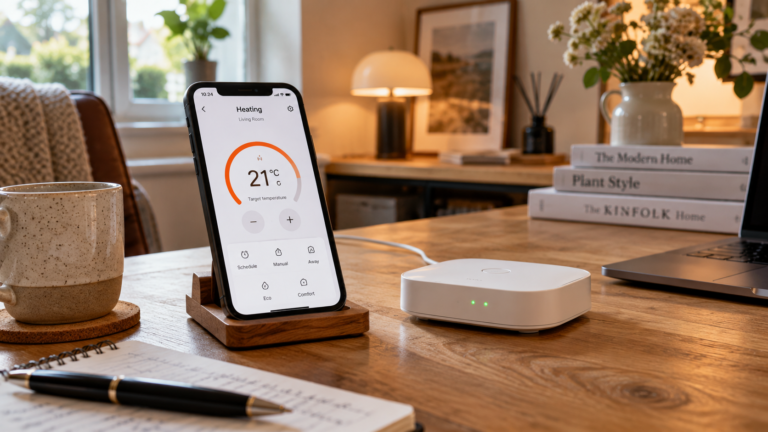
A WiFi thermostat typically connects to a compatible home router, allowing remote heating adjustments through a supported smartphone app.
This can be a straightforward option if you’re installing one or two thermostats and don’t already use a Zigbee smart home system.
Many WiFi models operate through 2.4 GHz networks and support platforms such as Tuya Smart or Smart Life.
Depending on the model, you may also be able to create heating schedules and use compatible voice assistants.
Zigbee Underfloor Heating Thermostats
Zigbee thermostats communicate through a compatible Zigbee network, usually requiring a gateway or coordinator for app connectivity.
This can be useful if you already have supported Zigbee devices or plan to connect multiple smart home products.
However, a Zigbee thermostat isn’t automatically more suitable for underfloor heating than a WiFi version.
The heating control output, sensor support and installation requirements remain the deciding factors.
Read our WiFi vs Zigbee Smart Thermostats comparison for more detail about connectivity, hubs and reliability.
If you’re considering Zigbee, our Zigbee Hub Guide explains what additional equipment may be needed.
5. Which Smart Thermostat Features Are Worth Having?
Smart underfloor heating thermostats can offer a wide range of features, but not all of them will be useful in every home.
Programmable Heating Schedules
Scheduling is particularly valuable for underfloor heating because the system may take time to reach the desired temperature.
You can set heating periods according to your household routine rather than manually changing settings throughout the day.
However, very large or frequent temperature changes may not be practical for systems with slow response times.
Remote Smartphone Control
App control allows you to adjust supported thermostat settings from your phone.
This can be useful when your plans change or you want to check the heating schedule without visiting each room.
Check whether the selected model requires a gateway, specific app or internet connection for remote features.
Floor Temperature Limiting
For suitable electric underfloor heating systems, the ability to monitor or limit floor temperature can be important.
However, this feature depends on the thermostat, connected sensor and configuration.
Temperature Calibration
Some thermostats allow adjustments to compensate for differences between the displayed temperature and a reference measurement.
This may help where thermostat positioning affects readings, although calibration cannot correct every installation issue.
Manual Controls
A clear display and straightforward physical controls are useful for household members who prefer not to use a smartphone.
Check whether basic temperature adjustment remains available during an internet outage.
Multiple Heating Zones
If your home has several underfloor heating zones, look for a system that supports the number of thermostats and controls you require.
Being able to view multiple thermostats in the same app is convenient, but doesn’t guarantee compatibility with an existing multi-zone wiring centre.
6. Smart Underfloor Heating Thermostats Available at PYC Online
PYC Online offers smart thermostat models with different versions for electric underfloor heating, water-based systems and suitable boiler applications.
The important point is to select the correct variant for your installation.
WiFi Smart Room Thermostat for Underfloor Heating
Our WiFi Smart Room Thermostat is available in several application-specific versions.
The product range includes:
- EP: Intended for compatible electric underfloor heating systems, including suitable heating mats and cables.
- WP: Intended for compatible water-based underfloor heating controls, including suitable valves and actuators.
- WPB: Intended for suitable boiler and dry-contact heating applications.
These versions have different control requirements and should not be treated as interchangeable.
The product listing specifies a 16A rating for the EP electric heating version and 3A for the WP and WPB versions. These figures are model specifications, not confirmation that any particular installation is compatible.
The EP version includes an external temperature sensor according to the product listing, while the other variants have different package contents.
Supported features include Tuya Smart or Smart Life control, programmable schedules and compatible voice assistant integration.
Before choosing a version, have the heating system and wiring requirements checked.
Zigbee Smart Knob Thermostat
Another option is our Zigbee Smart Knob Thermostat, which offers a rotary control interface and connected heating features.
This product is available in separate variants intended for electric heating, water heating and suitable gas boiler applications.
The listing specifies different switching ratings for the electric and water heating versions, so choosing the correct variant is essential.
Features include weekly programming, temperature calibration, app-based control through a compatible Zigbee gateway and supported voice assistant integration.
Always confirm that the selected variant supports your heating system, sensors and wiring before purchasing.
You can find additional options in our Smart Thermostat and Heating Controls collection.
7. Can You Replace an Existing Underfloor Heating Thermostat?
In many cases, an existing underfloor heating thermostat can be upgraded, but it isn’t always a direct replacement.
Two thermostats may fit a similar wall mounting arrangement while having different electrical connections or sensor requirements.
Before replacing your current thermostat, check:
- Whether your heating system is electric or water-based.
- The supply voltage and output requirements.
- The connected heating load or actuator control arrangement.
- The existing floor sensor type and compatibility.
- Whether your system uses a separate wiring centre.
- The physical mounting requirements and available wiring.
- Whether a compatible gateway is needed for smart functions.
For electric underfloor heating, the existing thermostat may be connected to fixed mains wiring and a substantial heating load.
These connections should be assessed and installed by an appropriately competent electrician.
For wet systems connected to boilers or heat pumps, a qualified heating professional should confirm the correct control arrangement.
Never select a replacement solely because the wiring terminals appear similar to those on your existing model.
8. Do Smart Underfloor Heating Thermostats Save Energy?
Smart thermostats can help you manage underfloor heating more effectively by allowing you to match temperatures and schedules to when rooms are used.
However, energy savings depend on your existing heating controls, building insulation, heat source and household routine.
Electric underfloor heating can be relatively expensive to operate because it uses electricity directly to produce heat.
Smart scheduling may help reduce unnecessary operating periods, particularly in bathrooms or other rooms used for limited periods.
Wet underfloor heating can work efficiently with suitable low-temperature heat sources, but its performance depends on the complete heating system and how it is controlled.
Because underfloor heating can respond slowly, constantly switching the system between very low and high target temperatures may not provide the results you expect.
The most appropriate schedule depends on the floor construction, heating system and how the space is used.
A smart thermostat doesn’t automatically reduce energy consumption simply because it’s connected to an app.
For a broader explanation, read our guide to smart thermostat energy savings.
9. Common Mistakes When Buying an Underfloor Heating Thermostat
Several common mistakes can lead to installation problems or unsuitable purchases.
- Choosing the wrong heating variant: Electric and water-based underfloor heating thermostats aren’t automatically interchangeable.
- Ignoring electrical ratings: The thermostat must be suitable for the heating load or control equipment.
- Assuming the existing floor sensor will work: Sensor compatibility must be confirmed.
- Buying based only on WiFi or Zigbee: Connectivity doesn’t establish heating system compatibility.
- Overlooking gateway requirements: Certain Zigbee thermostats need a compatible gateway for app control.
- Ignoring floor temperature limits: Some flooring materials and heating installations require appropriate temperature limiting.
- Expecting instant heating: Underfloor heating may respond more slowly than radiators.
- Assuming every thermostat works with every wiring centre: Wet systems can have different actuator and control requirements.
Taking time to verify these details before ordering can prevent unnecessary expense and installation delays.
Underfloor Heating Thermostat Buying Checklist
Before choosing a smart thermostat, make sure you can answer the following questions:
- Do I have electric or water-based underfloor heating?
- What thermostat or heating controller is currently installed?
- Does my system use an external floor temperature sensor?
- Is the new thermostat compatible with that sensor?
- What electrical load or actuator control rating is required?
- Does my system use a manifold or wiring centre?
- Do I prefer WiFi or Zigbee connectivity?
- Will I need a separate gateway?
- Do I need multiple heating zones?
- Does the thermostat support the schedules and settings I want?
- Have the installation requirements been checked by a competent professional?
Compatibility should always take priority over appearance or additional smart features.
Frequently Asked Questions
Can I use any smart thermostat with underfloor heating?
No. You need a thermostat designed for the correct type of underfloor heating and compatible with its wiring, switching requirements and temperature sensors.
What’s the difference between electric and wet underfloor heating thermostats?
Electric underfloor heating thermostats may control a suitable electrical heating load directly. Wet underfloor heating thermostats generally control actuators, valves or associated heating equipment.
Do I need a floor sensor for electric underfloor heating?
Many electric systems use a floor sensor, particularly where floor temperature limiting is required. Check the heating and flooring manufacturer’s instructions and confirm that the thermostat supports the correct sensor.
Is WiFi or Zigbee better for underfloor heating?
Both can provide effective smart control. WiFi may be simpler for a standalone thermostat, while Zigbee can be useful within a compatible smart home network. Heating system compatibility is more important than the wireless protocol.
Can a smart thermostat control several rooms?
Some systems support multiple heating zones, usually with separate thermostats or sensors and suitable zone control equipment. One basic wall thermostat doesn’t automatically provide independent control of several rooms.
Can I replace a traditional underfloor heating thermostat with a smart one?
Often, yes, but the replacement must support the existing electrical connections, heating controls and sensors. A competent installer should verify compatibility before any wiring changes.
Do smart underfloor heating thermostats work without the internet?
Some provide basic local temperature control when internet access is unavailable, but remote control and certain automations may stop working. Offline functionality varies by model.
Will smart underfloor heating save money?
Smart controls may help reduce unnecessary heating through schedules and temperature management, but savings depend on the system, existing controls and how it’s used. No particular saving is guaranteed.
Final Thoughts
The best smart thermostat for underfloor heating isn’t necessarily the most expensive model or the one with the longest feature list.
Start by identifying whether your system uses electric heating elements or circulating hot water. Then check the electrical controls, floor sensors and installation requirements.
Once compatibility has been established, you can decide which smart features are useful, whether that’s remote smartphone control, heating schedules, temperature calibration or integration with other connected devices.
For UK homes, choosing the correct thermostat variant is essential. Two products may look identical while being designed for entirely different heating systems.
Explore our Smart Thermostat collection at PYC Online to compare available options and select the version suited to your installation.
Related Guides
- How to Choose a Smart Thermostat for Your Home: UK Buying Guide
- WiFi vs Zigbee Smart Thermostats: Which Is Better?
- Will a Smart Thermostat Work With My Boiler?
- Smart Thermostat vs Smart Radiator Valves
- Smart Radiator Valves Explained
- Do You Need a Zigbee Hub for a Smart Thermostat?
- Do Smart Thermostats Save Money on Heating Bills?
Further Reading
- Energy Saving Trust: Electric Heating – Guidance on electric and water-based underfloor heating in UK homes.
- Energy Saving Trust: Heating Controls – Information on heating zones, thermostats and managing temperatures.
- Electrical Safety First – Information about electrical safety and competent installation.
People Also Search For
best smart thermostat for underfloor heating, smart underfloor heating thermostat UK, electric underfloor heating thermostat, water underfloor heating thermostat, wet underfloor heating controls, WiFi underfloor heating thermostat, Zigbee underfloor heating thermostat, Tuya floor heating thermostat, underfloor heating thermostat with floor sensor, smart thermostat for heating mats, underfloor heating zone control, underfloor heating thermostat replacement, underfloor heating thermostat compatibility, smart heating controller UK
Leave a comment